
Data Centers Are the Hottest Market in Construction, But Are They Your Market?
by David Morton, Maxim Consulting Group
Every subcontractor in America is hearing some version of the same advice right now, “Get into mission critical!”
The pull is real, and the numbers back it up. In the 2026 Construction Hiring and Business Outlook from AGC and Sage, 65 percent of contractors expect the data center market to expand over the coming year, while just 8 percent expect it to contract. That nets out to a +57 percent positive outlook, the strongest reading of any sector they track. Deloitte credits AI driven data center and energy work for the bulk of the modest growth forecasted in 2026, while commercial and residential markets remain soft.
So one market is shouting, “Look at me!” while the rest of the board goes quiet. That is exactly the moment contractors tend to make their worst decisions.
Know Your Capabilities First
Michael Porter offered one of the clearest definitions of business strategy in his 1996 Harvard Business Review piece aptly titled “What is Strategy?” The answer was refreshingly simple.
“Strategy means performing different activities than your rivals do, or performing similar activities differently.”
For subcontractors, that becomes a question of identifying what types of buyers they are built to serve. Picture two glazing contractors. One thrives on fast-track curtain wall projects for commercial developers while the other focuses on meticulous historic restorations for institutions. Both hang glass, but they are very different businesses with vastly divergent capabilities.
Segmentation means identifying the buyers for whom you are the obvious solution, rather than trying to adapt your
talents to be a potential solution for everyone else. Most subs hate that idea, because narrowing their focus feels like turning away revenue. But a firm that looks like everybody else competes on price alone, and in this business that means competing on whose estimator made the biggest mistake.
That brings us to core competencies. I had the good fortune of learning from renowned business strategist C.K. Prahalad at The University of Michigan, coauthor of Competing for the Future. One of his ideas has guided me ever since, “Core competencies are the wellspring of new business development.” Know your capabilities first. The markets you can effectively serve will follow.
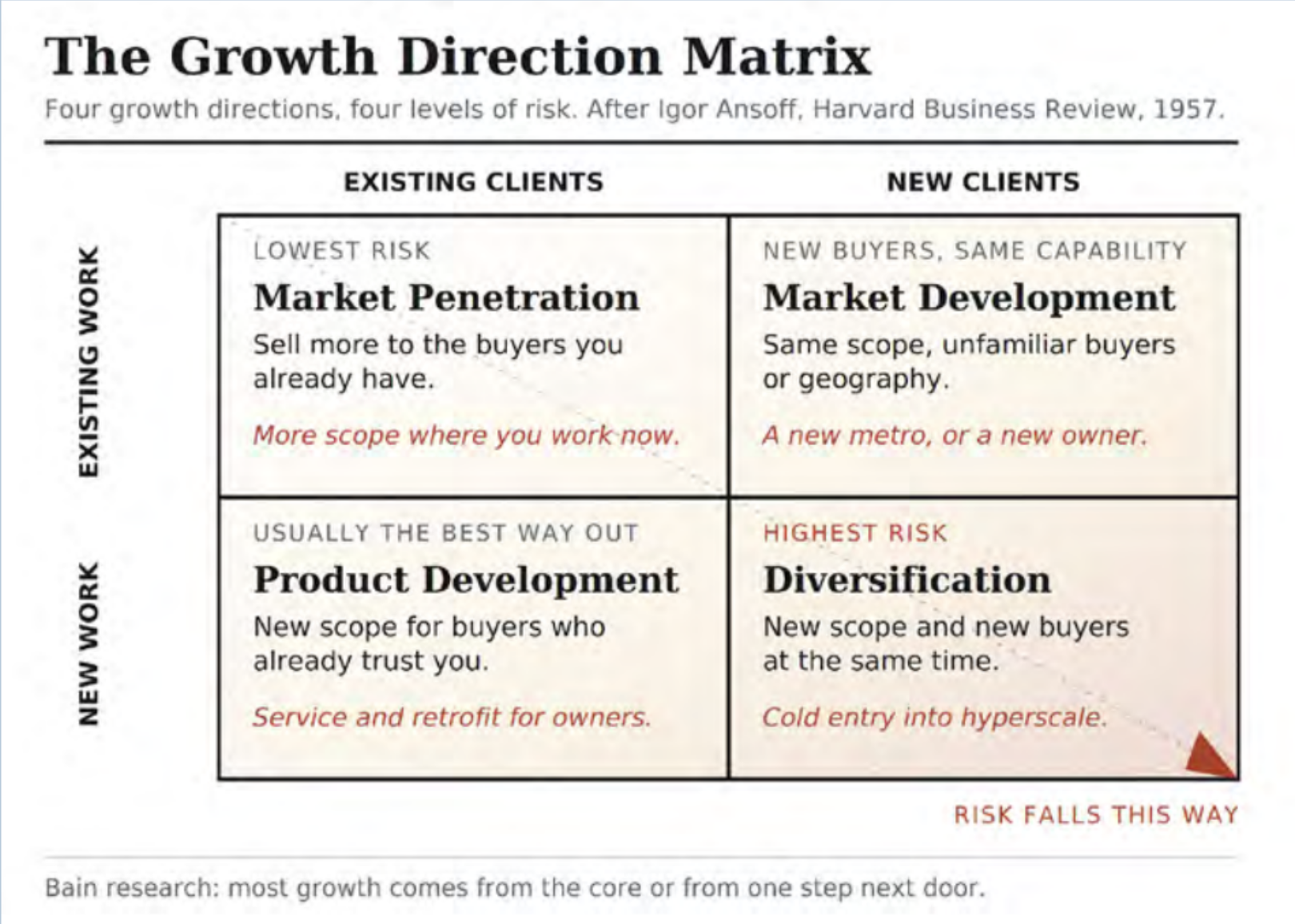
Figure 1
Four Directions, Four
Different Risks
Once you know your competencies, the standard product market map sorts your options fast (Figure 1). Existing services to existing clients is penetration.
Safe harbor, best return on effort, lowest risk.
New, but related services to existing clients is product development. The relationship and the credibility already exist, so you are only adding adjacent scopes. For most subs this is the best path to growth, because the hardest part of construction sales is building trust, and that work is already done.
Existing services to new clients is market development, the same scope sold to unfamiliar buyers or new geographies. New services sold to new clients is full diversification, the riskiest of the four because you are building both new capabilities and new relationships at the same time.