BY STEPHANE McSHANE
Improve Your Company’s
Billing & Collections

BY STEPHANE McSHANE
Improve Your Company’s
Billing & Collections
Contractors take on tremendous risk when they perform work. However, more contractors go out of business due to poor cash flow than lack of profitability. Why? Is there as much emphasis on billing and collections as there is on daily construction operations? While management executives typically have a firm grasp on the cycle of cash through their organizations, what does the financial acumen of your remaining staff look like?
More importantly, how educated are your PMs, project administrators, and A/R clerks in the art of billing and collections? Are your company’s systems and processes standardized in these critical areas?
A contractor’s cash flow is largely driven by one thing: the cash flow of its individual projects. In this article, we will discuss the key indicators that are necessary to give early warning to cash flow issues, the importance of a properly crafted schedule of values, how to implement a structured billing process, and how to define the internal escalation process for collections.
Key Indicators
When a project’s cash flow goes south, it is not usually a surprise. Your team can spot the early warning signs only if it has the right tools and knows how to use them. There should be standard reports both at the corporate and project levels that allow for cash flow visibility. While monitoring cash flow at the corporate level is important, the solutions to cash flow are derived at the project level.
Corporate Level
It is critical to monitor key financial indicators at the corporate level so that upper-level managers can detect a cash flow issue early. There are many items to review regularly that can serve as early warning signals.
At the enterprise level, monitoring current ratio and quick ratio give a snapshot in time of the asset to liabilities calculation as a roll-up. Establishing minimums for these ratios and building red flags into your reporting structure is key
to identifying issues quickly. Analysis of working capital by dollars, percentage, and yearly turnover are also important indicators of the company’s financial health.
From the corporate perspective, a roll-up of project overbillings and the cash position are also essential to review. Lastly, looking at debt to equity ratios and establishing a maximum threshold for this is also an important data point to monitor. All of these are key indicators that would compel you to dig deeper once a problem was identified. (You can also use such tools as CFMA’s Financial Benchmarker to compare this data. Visit www.financialbenchmarker.com.)
Many companies create a balance sheet and income statement either monthly or quarterly. Interestingly, fewer publish a statement of cash flows. Best in Class companies also publish a forward-looking cash projection, which could be crafted as a 12-week look ahead based upon the projects on the WIP and the PMs’ understanding of their project schedules and work planned. This cash projection gives the company time to react to an oncoming shortfall more effectively.
(Read more on creating a forward-looking financial forecast in “Turning Numbers Into Insight: Enhance Your Influence & Credibility” by Philip Campbell in the January/February 2015 issue.)
Project Level
There are relevant indicators that can be created at the project management level. Within your company’s job status report, there should be two very clear indicators of cash position of the project: overbillings/underbillings and net cash position. During the monthly project review, these two key data points should be reviewed and expectations for the PMs to uphold should be set.
The PM is the singular point of responsibility over a project. There is a distinct difference between a “Project Witness” and a “Project Manager.” If expectations are clearly set around overbillings, such as a net overbilled position of at least 20%, this can be measured and the PM can be held accountable.
March/April 2015 CFMA Building Profits
accounting & REPORTING
There is a quantifiable data point to measure the PMs’ effectiveness in this area. This measurable can be incentivized, drive the desired positive behavior, and turn those who might be simply witnessing a job’s cash position into those who want to drive it and ensure that they hit their targets.
The very same can be said for the net cash position, which simply states how much has been paid out vs. what has been collected. While this may seem remedial to some, driving this level of knowledge to the project level is key. A true PM wants to manage all of the direct job costs, the billing, and the collections process. (Billing and collections strategies will be discussed later on in this article.)
Schedule of Values
Creating a schedule of values includes the mechanics of how the budget cost data is procured and organized, what format to use to ensure that the correct costs fall into the correct categories, a review of the schedule of the project to clarify which activities will occur early in the project, and correct assignment of the general conditions and start-up costs (e.g., mobilization, design, detailing, submittals, material procurement, and prefabrication).
If a schedule of values is done poorly, then maintaining a positive cash position is virtually impossible.
A controversial piece to define is whether or not to front-end load the schedule of values and, if so, by how much. This is an enterprise-level decision that should be driven by the type of vertical markets your company serves, the normal payment terms of your client base, and your company’s position on the topic. (Refer to “Taking Risks with Numbers: How Far Can You Go?” by Susan L. McGreevy & Kathryn I. Landrum in the September/October 2014 issue for more on this topic.)
Should front-end loading become a company standard, the minimum percent frontload should be a calculation on the schedule of values tool, to be reviewed for compliance and used as a metric for a PM’s performance.
The goal of an effective schedule of values is to get paid for overhead and profit as quickly as possible, and is the single greatest impact a PM can have on his/her project cash flow.
Billing Strategies
Your company’s internal billing process should be well defined, communicated, reviewed, and measured. Let’s take a look at a sample billing process:
Repeat for Each Line Item on the Billing
1) Review the existing cost to date for labor, material, and other direct job costs
2) Identify additional costs of each direct job cost projected through the end of the month
3) Evaluate the percent complete
4) Mark up the billing item with the percent complete
Quality Check
1) Verify the total billing amount for all line items
2) Verify this total billing amount meets or exceeds the minimum established billing amount
3) Call or visit the client, review the bill, and get “pencil approval” prior to submission
To clarify this example, let’s discuss the minimum established billing amount. While some contractors take a “bill as much as you can” approach, this is not a measurable target. When discussing a minimum billing amount, targets should drive the positive revenue recognition that is the goal of a billing process.
For example, the minimum billing amount could be set at percent complete of the project plus 20% of cost. This approach verifies how effective the schedule of values is at driving positive cash flow.
May/June 2015 CFMA Building Profits
The reason that 20% of project costs to date is added is due to the cost of capital encountered by having retainage withheld, and payment cycles that typically hover between 45 and 60 days. Establishing the minimum billing amount and method should be standardized, and billing amount approval should occur before sending to the client.
Too often, billings are submitted and then kicked back for revision. Sometimes the owner or GC does not agree with the billing amount, causing tremendous rework inside of the accounting group to revise the amounts. We have also seen billings that were submitted 60 or 90 days prior get kicked back, causing all of the subsequent billings to be recalculated and reissued. Depending on your company’s accounting software, this can cause both a time delay to process and tremendous labor expenditure to accomplish. This also has a devastating effect on cash flow since it is much later in the payment cycle to even be approved, much less the waiting time to receive a check.
One solution is to get billings “preapproved” prior to submission: Walk the owner or GC through the billing, and have him or her sign off on your preliminary copy. This is critical in helping to avoid the billing adjustment scenario, thus keeping you in the correct payment cycle and driving a shorter wait to actually receive payment.
When a billing is withheld, the cause is often something that the PM forgot to do (e.g., waivers not submitted, certified payrolls not included, etc.). To prevent these types of delays, the billing process should include a job-specific checklist so that all required documentation is included each time a billing is submitted. We cannot always control what the other party does with our billing, but we can control our ability to meet the contractual requirements in a timely manner.
There also seems to be a tremendous challenge at the end of projects to get final billings approved. So, the amount placed on final billings should be held to a minimum.
Here are some strategies to consider: • Ensure that the last regular progress billing is as large as possible, keeping the final billing amount small. Progress bills are much easier to get approved than a final billing. • Delay submitting a final billing if substantial progress is made and collection has been difficult. Instead, submit an additional progress billing.
• Set up a separate contract or purchase order for small, last minute change orders. Don’t hold up a $200,000 retainage for an additional month or two for a $1,200 change order that contains $400 in margin.
• Ask for preliminary approval of the final billing in advance, similar to the preapproval of the progress billings previously discussed.
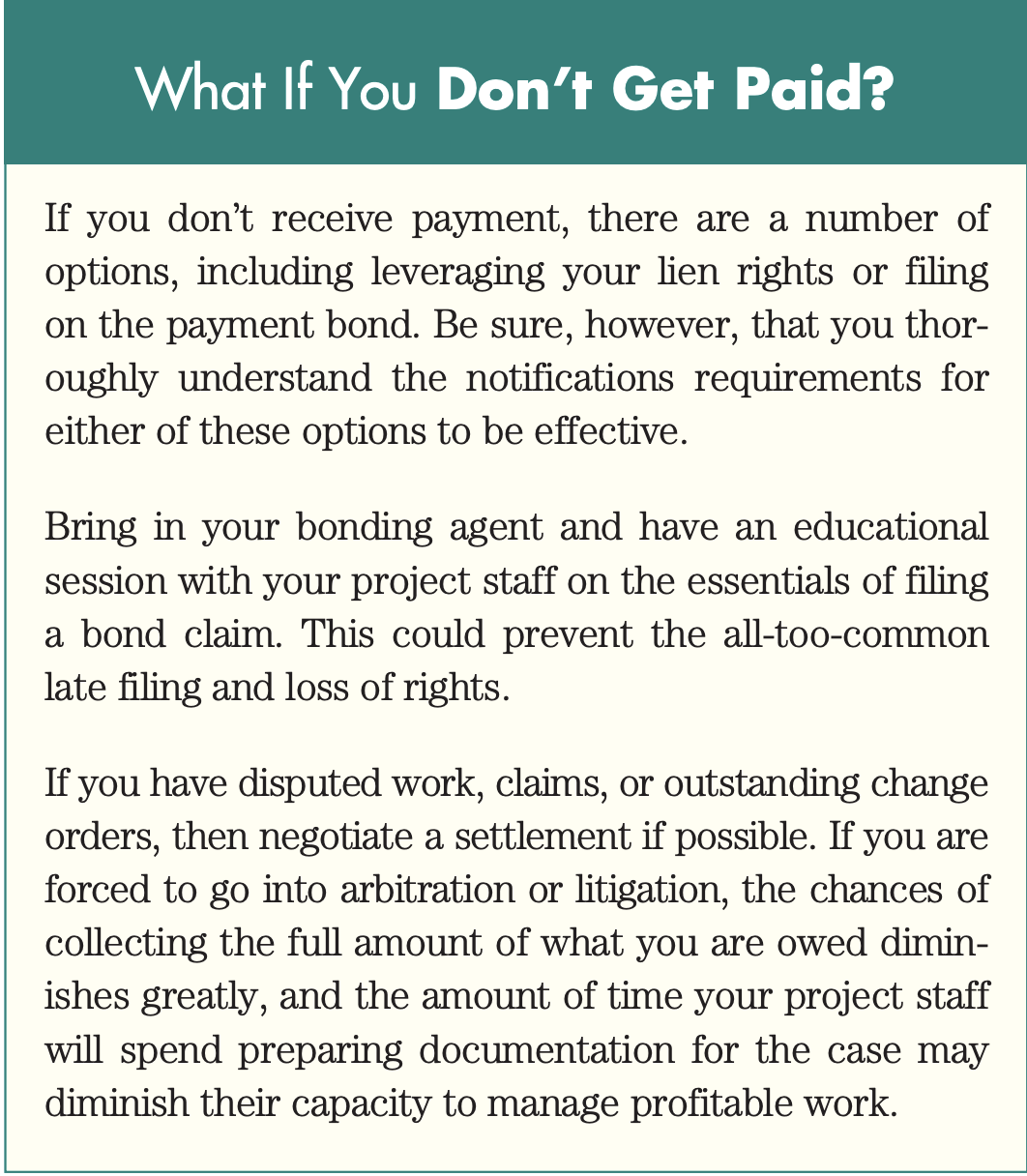
• Use the waiver of your lien rights as leverage to get final billings approved.
Collections
While the PM may not be the person performing each of these tasks, he or she must ensure that items are accomplished in a timely manner in order to release payments quickly. The PM has the relationship with the client, and must be on the collections team.
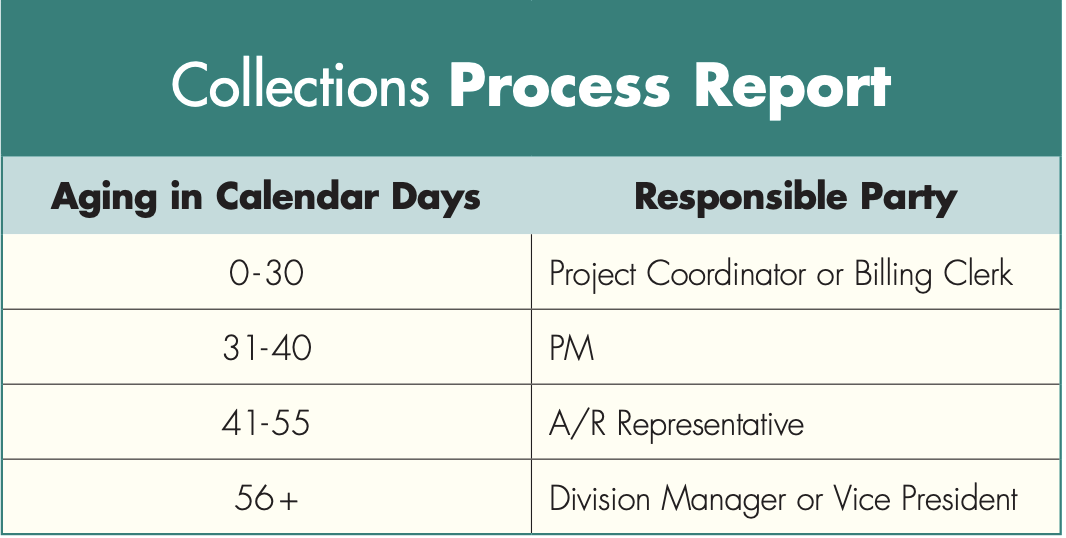
Defining levels of ownership of the collections process is a method by which a person is assigned responsibility over a project’s receivables for a specific period during the aging. As the receivable gets older, it becomes the responsibility of a higher classification of employee, thus escalating the level of personnel handling it until the collection has occurred. Most companies are great at publishing an aging report. Assign a job title to each aging period to establish who owns the account at that moment. (See Collections Process Report.)
The collections process should document the actions taken at each level of aging and explain how documentation is to occur. The project coordinator should pursue the contact weekly, recording each step of the way. Once the aging has reached 31 days, it becomes the PM’s responsibility to contact the recipient and document this information on the same project collection log.
This continues until the bill reaches the 41st and 56th day, each time transferring ownership up the company chain so that they may reach out to their peers at the client office in order to resolve the issue. This affords the opportunity to consistently communicate nonpayment and secure a customer’s commitment to pay.
CFMA Building Profits March/April 2015
accounting & REPORTING
As with any process, the days sales outstanding (DSO) of a project is measured and rolled up by the PM, A/R representative, and division manager as another very effective performance metric. (A more detailed look at this process can be found in my article on how to “Improve Project-Level Cash Flow with Training & Education” in the July/August 2014 issue.)
Conclusion
Monitoring key indicators can enable early warnings of a cash flow issue. The development, implementation, and monitoring of effective schedule of value practices, billing strategies, and collections processes increase the chances of collecting the full revenue due, help drive down the timeline between submission of billing and receipt of payment, and place your company in a positive cash position earlier, thus reducing the cost of capital to perform work.
In addition, these processes establish levels of ownership and the ability to both measure and incentivize the right behaviors to keep cash flow positive for each project and the company as a whole.
STEPHANE McSHANE is the Associate Director at Maxim Consulting Group in Denver, CO, where she is responsible for the evaluation and implementation processes with the company’s clients. Stephane works with construction related firms of all sizes to evaluate business practices and assist with management challenges.
A previous author for CFMA Building Profits, Stephane has authored for ASA’s Contractor’s Compass and has presented at numerous engagements across the U.S. and Canada for ASA, ABC, NECA, SMACNA, numerous builders associations, and private contractors.
Her areas of expertise include leadership development, executive coaching, organizational assessments, strategic planning, project execution, business development, productivity improvement, and training programs.
Phone: 303-688-0503, ext. 706
E-Mail: stephane.mcshane@maximconsulting.com
Website: www.maximconsulting.com
May/June 2015 CFMA Building Profits
© 2026 Maxim Consulting Group. All Rights Reserved.
