
WWW.ASAONLINE.COM DECEMBER 2015

The Flight of the Managers— When a Compensation Problem is NOT a Compensation Problem
Improve Bottom Lines by Managing Driver Selection and Cell Phone Distracted Driving
Building for the Future— Addressing Construction Industry Workforce Issues
SPECIAL FEATURE: Drones in the Construction Industry
Commercial Construction Marketing: How Do You Measure Up? On-Page SEO
Subcontractors and the ACA: Preparing for 2016
Top Trends in Merchant Processing
Legally Speaking: Do You Want to Be Paid for Extra Work?

Building for the Future — Addressing Construction Industry Workforce Issues
by Laura Cataldo
The economic reports sound quite promising for the construction industry: 22 percent increase expected for 2016, private construction is booming, and infrastructure investment is strong. Yet almost every economic forecast includes a warning that the lack of skilled workers will make this growth opportunity next to impossible to meet.
Predictions of workforce shortages may be scary, but they can help us understand the challenges our industry faces and identify solutions for ASA members and chapters.
War for Talent
There are many reasons why the workforce shortage is hitting the construction industry hard:
• Aging workforce.
• Dislocated workers that are not returning to construction.
• Lack of diversification.
• Image issues with younger generations.
The impact that the recession had on the retirement of Baby Boomers has been well publicized. Many that were near or at retirement age elected to remain in the workforce after
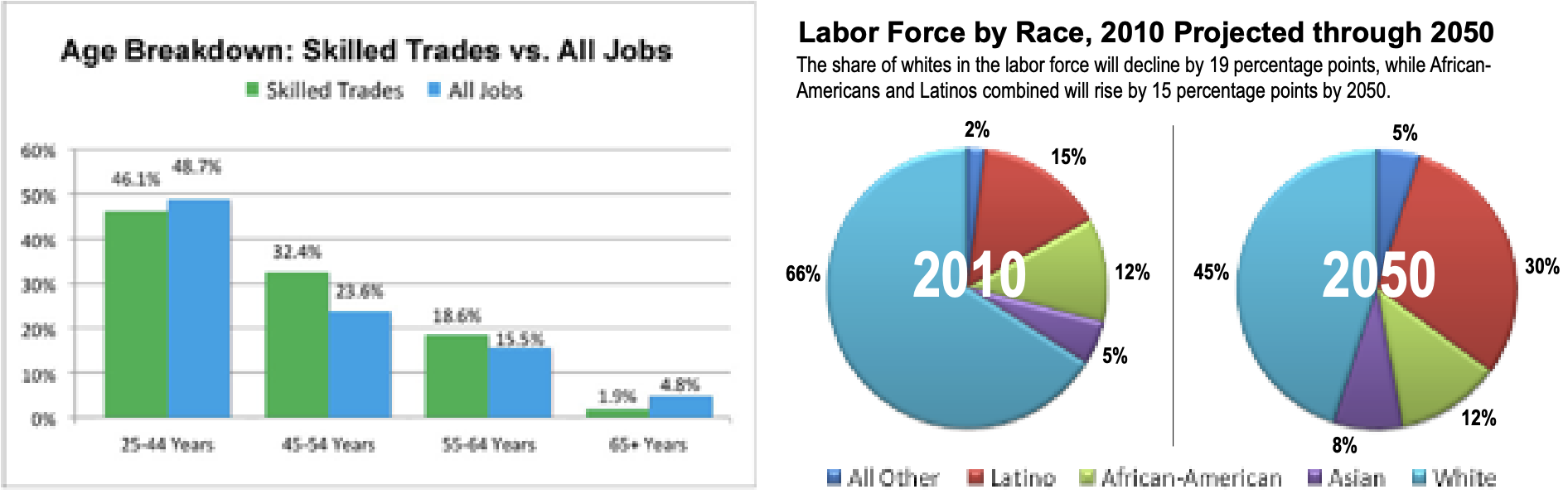
losing a substantial amount of their retirement funds. These same workers are now planning an exit strategy, if they have not left the industry already. Interestingly, the construction industry skilled trades are older on average than other industries: More than 53 percent of the trades are over the age of 45, compared to only 44 percent of other industries. Given the physically demanding nature of the construction trades, this statistic seems counterintuitive, but does an outstanding job of demonstrating that we have an aging workforce.
A recent Wall Street Journal article, “Where have all the construction workers gone?” found that many of the workers laid off during the recession have moved on to other industries and have no plans to return. Recent employment numbers suggest that the nation is nearing a saturation point of eligible employment. With nationwide unemployment close to half of 2010, and as low as 4.3 percent in some states, there simply is not a surplus of workers available to work.
The demographics of the construction workforce do not match the labor force. In 2010 the workforce was composed of 15 percent Latinos, 12 percent African Americans, and 5 percent Asians. Very few companies
can state that their workforce aligns with national statistics. The reality is that, on average, the construction workforce is middle-aged white males. The strategy moving forward must include the implementation of change to bring the demographics in much closer alignment to national statistics. To accomplish this necessary action, the construction industry needs to do much more to diversify its workforce. This would also include significant efforts to attract women to the construction workforce as well.
Many schools across the country have adopted a “college for all” mentality that has negatively impacted the construction industry’s ability to reach young people. Career and Technical Education has been declining for the last 20 years, as schools emphasized college preparation, not career preparation. Students today do not have the opportunity to experience the high-tech nature of the rapidly changing construction industry. In fact, some counselors threaten construction careers as the “last choice” if you cannot make it in the high school system. What happened to seeking the “best and brightest?”
No wonder economic reports are undermined by warnings of a workforce shortage — the construction
DECEMBER 2015 THE CONTRACTOR’S COMPASS
industry workforce is aging, it’s not diverse enough, and it isn’t attractive to young people. That said, there is plenty of good news on the horizon for the industry and opportunities to engage in workforce initiatives on the local level!
• Both federal and state governments are committed to workforce development, as it is critical to economic development.
• Education is starting to shift back to an emphasis on college and career preparation, providing the perfect opportunity for the industry to reach out an engage the future workforce.
• The construction industry is uniting through national efforts to find solutions to recruit and retain a future workforce.
A main topic at this year’s National Governor’s Conference was workforce development. Economic development is only possible when employers are successful and this requires a productive workforce. The Federal Workforce Innovation and Opportunity Act provides $9.8 billion a year and is the single largest source of federal funding for job training and career services. WIOA promotes apprenticeship and industry credentials, such as NCCER, and provides reimbursement for employerdriven, work-based training. Sounds too good to be true, doesn’t it?
How can the construction industry position itself to get access to this $9.8 billion to ease its workforce challenges? Opportunity America has partnered with industry organizations and construction employers to develop this Roadmap to Workforce Solutions. The roadmap identifies four ways that companies can engage workforce development in their own communities.
Influence Policy
WIOA funds are awarded to each state by the Department of Labor. State and local Workforce Investment Boards are the bodies that identify which industries get priority for funding, determine how much money is awarded, and provide training and employment services. ASA members and chapters can have significant influence by volunteering to serve
on state and local WIBs. At the very least, make sure that the construction industry is represented on these boards. As with most things in life, you have to be at the table in order to take advantage of the opportunities available. Find your workforce board: http://www.servicelocator.org/ workforcecontacts.asp
Hire Workers
If your company participates in a registered apprenticeship program, WIOA provides funds to make hiring pre-apprentices and apprentices easier. One Stop Centers are the outreach arm of local WIBs where job seekers can access job listings and career services. Most of the potential employees that you will engage through the One Stop Centers are untrained in the skills required by the construction industry. WIOA funds can be used to provide basic skill training, test readiness, and work experience for those interested in the apprenticeship pathway. Individual Training Accounts provides vouchers for individuals to receive training through community colleges, vo-tech centers, for-profit training centers, trade associations or union training programs. The local WIB will help connect you with other partners, such as Community Based Organizations, that can assist the hiring process by targeting outreach programs at a more diverse population.
Partner with Educators
Engagement at the local level with the K-12 school system is critical to educating teachers, students and parents about the tremendous career opportunity our industry offers. This can be as easy as offering to donate equipment and materials for classroom projects, hosting jobsite visits, providing guest speakers in the classroom, participating in organized outreach programs like ACE Mentoring, and utilizing students for job shadow and internship employment. Dispel the myth that a construction career means you shut the door to continuing education by sharing information about apprenticeship and the tremendous opportunities to advance. Many educators and guidance counselors
do not understand the apprenticeship system and that many states offer technical college credits for apprenticeship. Unlike most industries, construction is one of the few where you can start out at virtually any position, and end up owning your own company some day, if that is your goal. We have a great story to tell, we just need to get out there and tell it in order to engage a future workforce
Seek Training Reimbursement
On-going training is very common in the construction industry as changing technology, OSHA requirements, and owner demands require a skilled workforce. Under WIOA, employers can seek funding for on-the-job and incumbent training for new and existing employees. On-the-job training funds cover 50 percent to 75 percent of the trainee’s wages, for a limited duration, in order to give workers the knowledge and skills necessary to do the job. Customized training to meet specific requirements of a job, such as Signaling training, also qualify for reimbursement as long as the training results in an industry recognized credential.
Trade associations, like ASA, are in the perfect position to help members develop local, regional and statewide partnerships to address workforce strategies. Utilize the collective experience, geographic reach and resources of members and industry partners to make the largest impact on the workforce opportunities that are facing us.
Laura Cataldo, associate director at Maxim Consulting Group, works with construction organizations of all sizes to evaluate business practices and assist with management challenges. Having worked in the construction industry for over 20 years, Cataldo offers a depth of experience working with contractors, associations and workforce partners to improve profitability and succeed in the changing marketplace. She understands the challenges of today’s construction marketplace and is keenly in touch with future trends. She can be reached at (608) 616-2835 or laura. cataldo@maximconsulting.com.
THE CONTRACTOR’S COMPASS DECEMBER 2015
© 2026 Maxim Consulting Group. All Rights Reserved.
