


This quote from the late newspaper columnist Sydney J. Harris highlights the challenge facing CFMs: Despite advancements in construction accounting technology, construction managers and field leaders are challenged by a lack of accurate, timely, and relevant financial performance feedback.
This article provides eight tips to effectively collect and communicate this critical financial information to key operations personnel, including project management and field employees.
Tip #1: Understand Your Internal Customers
While external customer value can be defined as “what your external customers are willing to pay for,” internal customer value is a little trickier. However, it can be viewed in a similar light: What key financial information helps operations personnel – your internal customers – deliver value?
One way to evaluate your internal customers’ financial information needs is to assemble a crossfunctional team and develop a list of internal customer groups.
Since some internal customers may lack financial management experience, it’s important to ask such exploratory questions as:
• What type of financial information will help you perform your job more effectively?
• How will you use that information?
• How frequently do you require that information?
• What format (e.g., electronic, hard copy, charts, graphs, trend lines) works best for you?

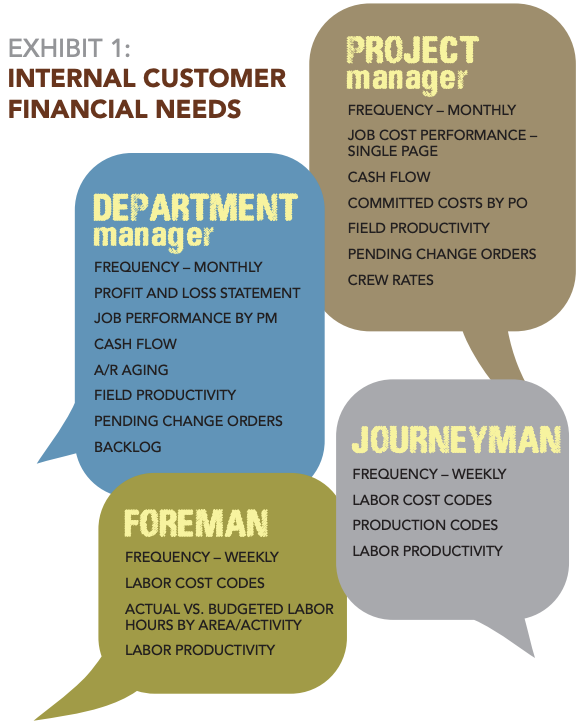
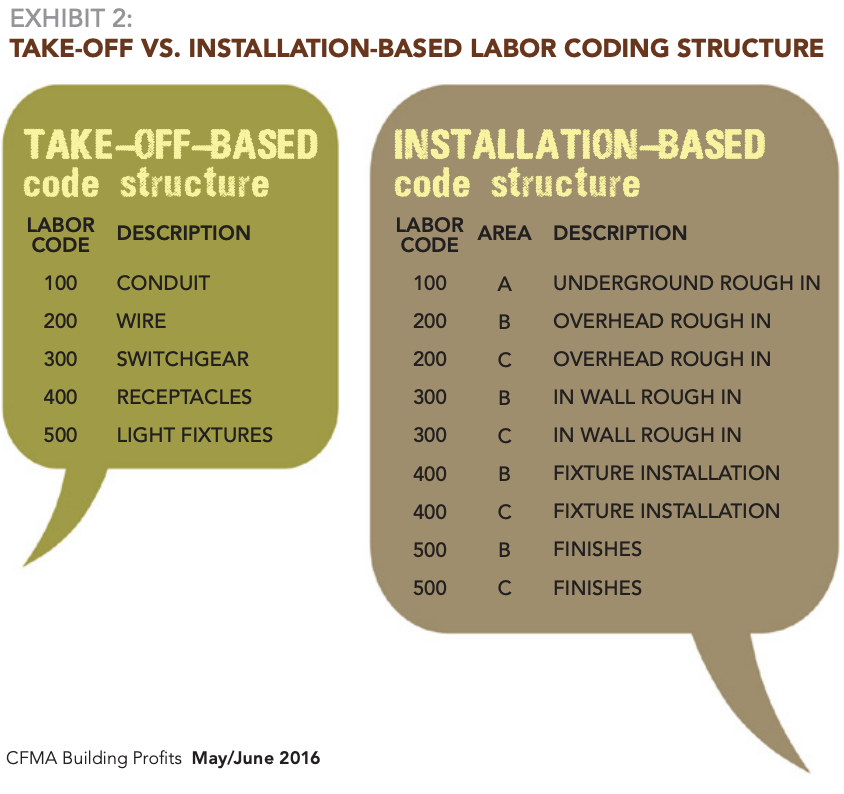
Exhibit 1 at left illustrates results from an internal customer value brainstorming session.
Tip #2: Standardize Cost Codes for the Field
When designing job cost structures, particularly labor cost codes, cost categories created by accounting and estimating don’t typically take the needs of project management and field leadership into account. Often, cost codes are broken out by material type and system rather than sequence of installation. While feedback to estimating is important, if the work is not broken out by the actual sequence of installation, then the data from the field will be inaccurate.
A more effective method is to map out the field installation process, identifying key activities that can be budgeted and tracked. This structure can be used to create standardized labor cost codes for all jobs, allowing for rollup information at the PM, department, and company levels. If further breakdown is required, then an area or phase designation can be used to keep the activities codes the same.
Exhibit 2 illustrates the transition from an estimating- or takeoff-based coding system to a field-centric coding system that aligns with the installation sequence for a typical electrical construction project. In this example, several of the standard cost codes are broken out by area for more detailed tracking.
Tip #3: Error-Proof Data Collection
Pay close attention to how performance report data – especially field labor and material costs – is collected and entered. While it may not affect payroll if labor and material are posted to the incorrect cost code, it can impact the quality of production feedback to the PM and field personnel as well as complicate their cost forecasting efforts.
Training as well as the use of an automated and controlled data entry process can improve accuracy. Employees responsible for filling out time cards should be trained on what codes to use for specific activities. At the beginning of each project, this training should be reinforced by reviewing the project budget and work breakdown structure.
Automation can also expedite the time entry process and reduce errors. Tradi
tionally, field employees manually record their labor hours in a field log, which is then transferred into a daily or weekly timesheet that is delivered to accounting. Accounting then keys the same information into the system to process payroll and post job cost.
This manual and duplicative process is not only inefficient, but it also increases the potential for errors. An automated time card system enables field employees to enter their time using drop-down menus that only allow them to select valid job and cost codes. Also, most time card approval systems can be configured with an approval routing that allows PMs or other designated reviewers to check for errors prior to posting.
Another common source of errors is material posting. Many companies still rely on verbal commitments or handwritten purchase orders to buy materials. These purchase orders may get forwarded to accounting for entry as committed cost, but often are missing such vital information as cost code or pricing. As the material invoices are received, accounting personnel must try and determine:
1) Items purchased, quantities, and units
2) Job number
3) Cost code
4) Price
5) Verification of material receipt
As an example, one A/P manager determined that 75% of invoices were delayed while this missing information was tracked down. Missing information can delay not only job cost posting, but also invoice payment and prevents the client from taking advantage of prompt payment discounts.
These errors can be reduced by centralizing the purchasing process and integrating purchasing software with an ERP that requires all relevant information to be entered prior to generating a valid purchase order.
This also allows for materials to be immediately posted as committed cost. Once the invoice arrives, automated matching software can match invoice to purchase order and receiving
report, again eliminating the need for manual research.
By automating both time card entry and material purchasing processes, job cost information can be posted quickly and effectively, enabling your internal customers to receive accurate and timely job cost reports.
Tip #4: Measure Field Performance
The real-time measure of field performance is productivity. Many PMs have difficulty defining productivity, and most foremen can only quantify it as it relates to field workers being productive. In most cases, productivity is defined as quantity installed divided by man-hours (or quantity installed divided by equipment hours).
In order to accurately measure field productivity, you must collect not only correctly coded labor hours, but also the production output (quantity installed or percentage of work activity completed). As with most processes, measurement of work activity installation or completion percentage can be simplified using construction accounting field modules or third-party software.
Tip #5: Tailor Your Communication
Try to match financial reporting to the roles and responsibilities of the position. A “one-size-fits-all” financial performance report for the operations manager or PM may seem beneficial, but it can result in one of two undesirable situations:
• Undersharing Information: The PM tells the foreman, “You are over on hours!” However, the foreman has no idea what activities experienced labor overruns or how to correct the problem.
• Oversharing Information: The PM provides the field foreman with a detailed job cost report that includes engineering hours and rates.
But instead of focusing on the work at hand, the foreman sees that the engineering hours exceeded the budget and believes the project will lose money regardless of what he does in the field.
CFMA Building Profits May/June 2016

By tailoring reports to provide only the relevant information for each role, you can filter out unnecessary data while retaining the level of detail that will drive desired behaviors.
In other words, translate financial information into the appropriate currency of trade. For example, if your foremen are responsible for managing the labor effort on a project but not for material, subcontract, or equipment cost management, then prepare financial performance reports that provide detailed labor information in terms of hours, not dollars.
Tip #6: Use Visuals to Relay Critical Data
Construction operations personnel need to quickly understand data and take action without becoming overwhelmed by too much data. Rather than tables full of data, use conditional formatting (e.g., red equals over budget, green equals under budget) and visual representations of numbers to highlight pertinent information to help personnel quickly assess data and take appropriate action.
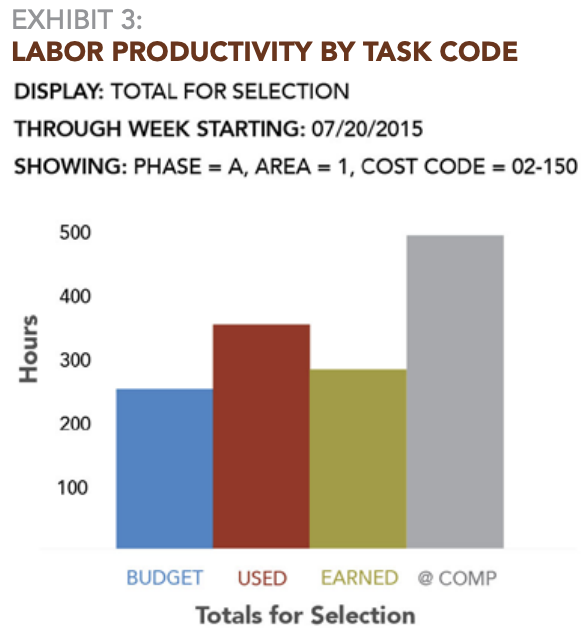
Exhibit 3 above illustrates how to visually relay important job performance information. It provides key performance data for one labor cost code. The blue column shows budgeted hours for this particular activity; red shows actual hours used; and green shows the calculated earned value (quantity installed to date/total budgeted quantity multiplied by budgeted hours). The gray column shows the projected hours at completion, assuming the same rate of productivity.
The field foreman does not have to know the formula for earned value to understand that there is a productivity issue. If the red column is bigger than the green column, then there is a problem.
Tip #7: Set the Right Tone
The tone of your communication is often as important as the information itself. This is especially critical during a project’s Work In Progress (WIP) meeting.
If your goal is to provide valuable, actionable information, then you must create an atmosphere of trust and transparency where performance problems are openly examined and solved rather than ignored or concealed.
As an example, our team has worked with PMs who would sometimes hide contingency dollars in their project budgets and forecasts so that if a cost overrun did occur, those funds could pay for the cost overrun without scrutiny from the management team. When pressed, the PMs explained that if the contingency money was revealed, then the CFO would likely remove it from the budget, which left the PM with no margin for error.
The solution was to create a contingency line item in the original project budget that decreased as the job progressed and performance risk diminished. Adding this simple line item to project budgets increased transparency and improved trust between the financial management and operations teams.
Tip #8: Knowledge Is Power When Used Wisely
Once you have relayed pertinent financial information, how do you use it?
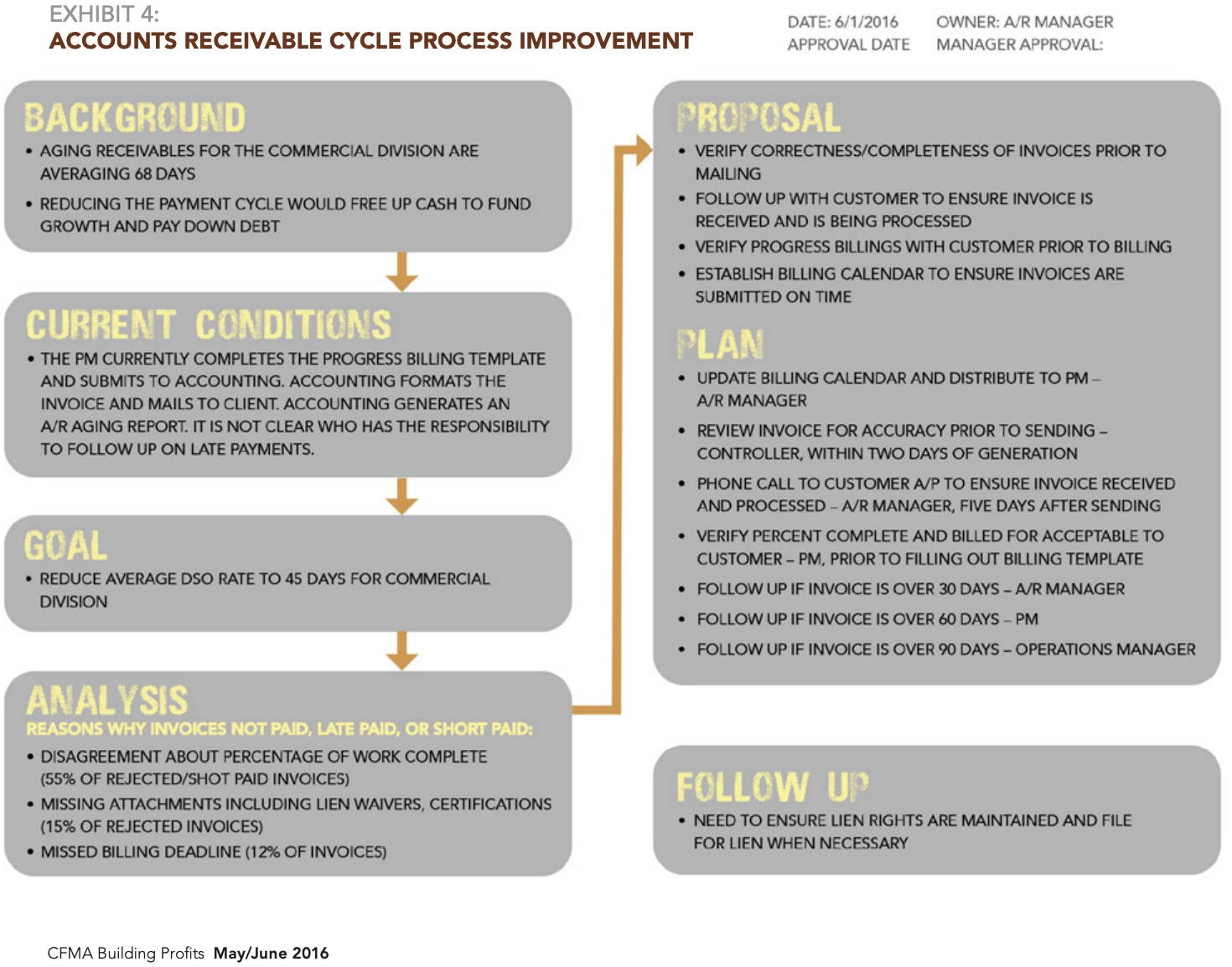
For example, if financial reporting indicates a consistent problem with aging A/R, how do you solve for it? What is the root cause – is it a billing issue, a collection issue, or a combination of multiple issues?
Having standard processes for continuous improvement and problem-solving are critical for maximizing the value of financial performance information.
Lean manufacturers use a model that includes defining the problem, clarifying the problem, analyzing root causes, developing and implementing solutions, and analyzing results. This same model can be applied in construction applications with measurable results.
May/June 2016 CFMA Building Profits
Exhibit 4 below shows a standard problem-solving process applied to an A/R aging issue. This approach enables crossfunctional teams, including members from accounting and operations, to work together to come up with effective solutions.
Summary
CFMs are the collectors and keepers of the data needed to measure operational performance.
Understanding what information your internal customers need, how to gather and communicate that information, and how to act on that information is critical to your company’s long-term success.
CHRISTINE RAHLF is an Associate Director at Maxim Consulting Group in Denver, CO. She works with construction-related firms of all sizes to evaluate business practices and assist with management challenges.
Christine has extensive experience in both the government and private industry, where she has managed complex projects and led technical teams to successful results. Her areas of specialization include productivity improvement, process reengineering, scheduling, cost control, risk analysis, and training.
Phone: 920-858-2350
E-Mail: christine.rahlf@maximconsulting.com
Website: www.maximconsulting.com
CFMA Building Profits May/June 2016
© 2026 Maxim Consulting Group. All Rights Reserved.
