

Merger and acquisition (M&A) deals have consistently created more substantial lasting value for companies through economies of scale than organic growth alone.1 Still, many shy away from acquisitions due to potential complexity, lack of clarity on acquisition goals, and an absence of in-house M&A experience.
M&A activity is often approached as another job that needs to be completed as soon as possible, without considering how the deal will fit into the overall company strategy
46 CFMA Building Profits July/August 2021
However, when an acquisition is approached from a strategic perspective and focuses on how it will drive competitive advantage, the deal becomes less of a transactional “job” activity and more of an integrated strategic opportunity.
This first installment of a three-part series on M&A will focus on the reasons for M&A, the design of a target operating model, ways to address people issues, and the risks of M&A.
Reasons for M&A Activity
Drive Company Value
While the end goal is typically to increase shareholder value, the company value created by this synergy of the two companies is greater than the sum of the two pre-merger companies. Synergy can be divided into cost and revenue.
Cost Synergy
A cost synergy will most likely result in a reduction in operating costs due to economies of scale. This is primarily because of shared services or fixed costs associated with the successful combination of the merged businesses, the reduction of duplicative services, and the distribution of those costs over a larger volume of business. These fixed costs are usually back office operations, IT systems, general management, and facilities.
Revenue Synergy
Revenue synergy is driven from a complementary revenue source like a new market, geographic expansion, or a product/service that offers diversification.
MERGERS & ACQUISITIONS
Reasons, Risks & Rewards
Diversify Customers & Markets
Customer diversification usually means expanding into new service lines to access new customers. In contrast, market diversification offers services in new areas for one of the companies involved in the merger. Additionally, the companies may devise a merger deal to lower the overall risk of one company’s operations. Both market expansion and additional services acquired through the merger allow for diversification of the company risk.
Increase Financial Capabilities
Every company has limited capabilities to finance operations concerning debt or selling equity. Many companies seek to acquire or merge with another company to create a consolidated entity to achieve a higher financial capability and deploy funds to grow the business further.
Reduce Competition
Sometimes a company may acquire or merge with a competitor to consolidate two businesses and achieve a single market share. However, this typically requires payment of a premium price, unless the target company is having financial or operational difficulties.
Tax Liability
One M&A strategy utilized by highly profitable companies is acquiring or merging with a company with a significant tax loss carryover. The merged companies will have a tax liability lower than the original company. Certain limitations apply to the timeframe and amount that can be carried forward in the combined entity, and special IRS restrictions apply to operational losses incurred as a result of an acquisition.
The rules are complex, and the unique transaction facts and circumstances determine the ability to take advantage of the losses in the combined entity.
Design the Target Operating Model
Define Organizational Chart & Roles
The target operating model should be designed based on the business role needs rather than the placement of specific individuals. To accomplish this, focus on the company’s vision and specific goals. This means defining the company organization chart and hierarchy, the individual responsibilities for each role, the scope of authority, decision escalation issues and levels, and profit responsibility goals for each area. This will align the hierarchy of the management roles with the organizational goals; only then should individuals be assigned to those roles. The underlying question that should be constantly asked is, “What are the cross-functional roles that drive value from the deal for the combined entity?”
At that point, an assessment should be performed to identify current personnel available and the skillset gap to fill those roles in the target operating model. The decision to either develop in-house training programs or contract with outside firms to close the skillset gaps is no small task but should be weighed against the risk of hiring a new employee for a management role.
Identify Challenges
When acquiring a company, it is also essential to identify the challenges faced by the existing team. Many companies focus entirely on the target company’s integration opportunity and do not attempt to understand the difficulties with their current business operations.
A best practice is meeting with employees at all levels to discuss and gain insight to incorporate corrections into the new merged target operating model. Having current employees share their input creates far less cultural opposition to change in the newly merged organization.
Maintain Communication
In a typical construction project, all parties hold detailed discussions and attempt to resolve major potential issues before breaking ground. The same is true for an acquisition or merger: create a detailed design plan, have conversations with all parties to clarify roles and responsibilities, identify potential issues, and prevent negotiations from occurring late in the M&A process.
July/August 2021 CFMA Building Profits 47
MERGERS & ACQUISITIONS
Reasons, Risks & Rewards
Once the target organization is designed and roles have been assigned, it is critical to communicate pertinent information about the new structure to the company. This communication should include people’s names, roles, and scope of authority to minimize any potential rumors and employee exits.
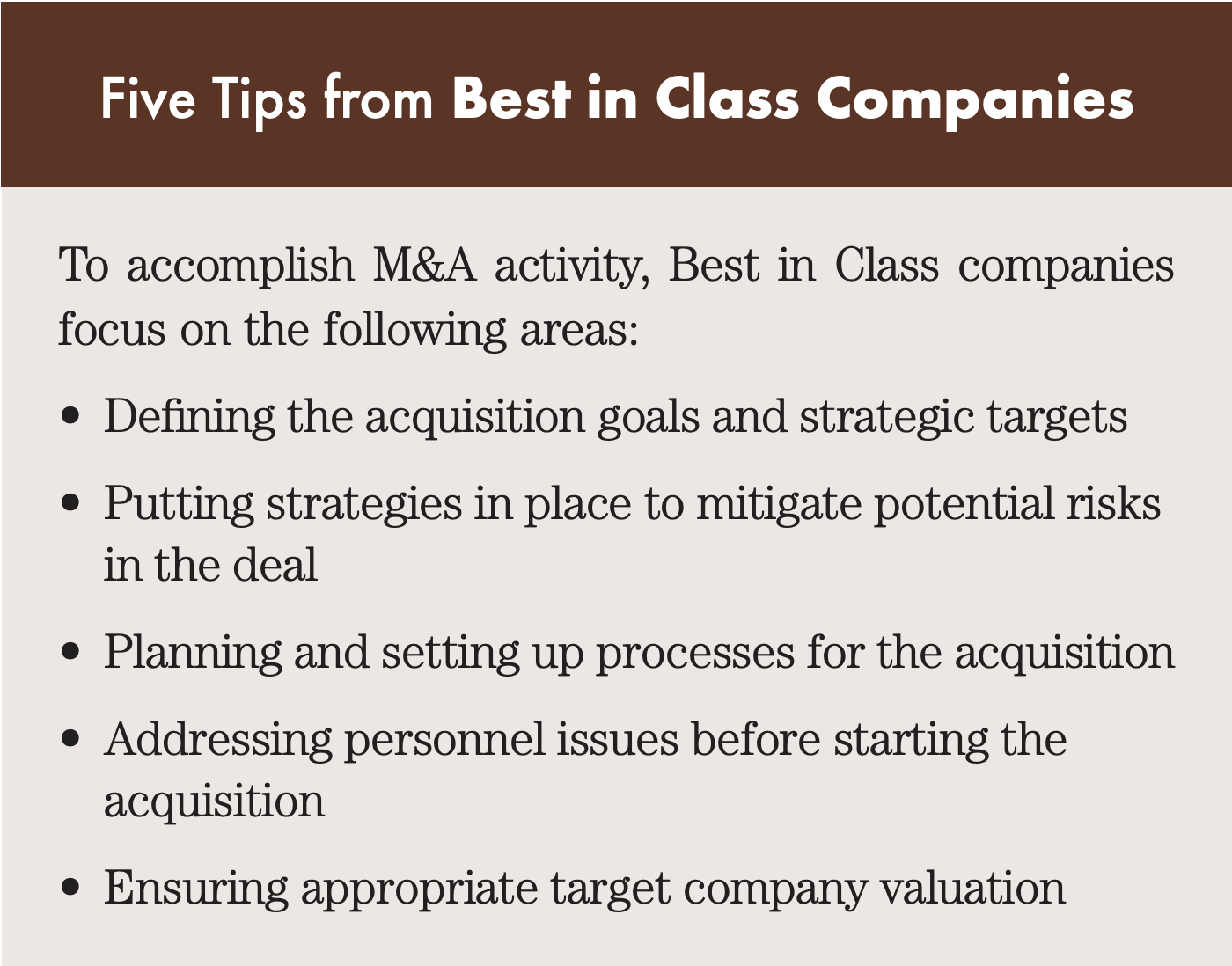
Address Personnel Issues Before Starting the Acquisition
A leading practice for retaining key talent is understanding the target operating model and any cultural differences between the two companies. Once this has been done, tailor the integration steps to address personnel issues on both sides. Identify how vital each target company employee is to the business in each of these four categories:
1) Pre-acquisition
2) During the merger and integration
3) Post-merger target operating model
4) Company-critical employee (required to maintain company operations at all stages)
The company must value the required short-term knowledge and account transfer and show who is needed to drive company value in the medium and long term.
Other personnel issues that need to be addressed early on in the process include:
• Retaining key talent and customer relationships through communication and introduction to other senior team members and support staff.
• Addressing the current ownership’s needs by identifying all of the issues that could come up later in negotiations, including valuation, current cash, debt servicing, purchase period, employment contracts and responsibilities, benefits extension, buildings and vehicles, and tax implications.
Valuation
In developing your company’s valuation for potential sale, here are some best practices:
• Establish a disciplined approach to strategic decision-making and standardized models
• Develop a risk map
• Translate value into deal-specific terms
• Develop alternative target models to improve the chances of achieving the expected
July/August 2021 CFMA Building Profits 47
• Do not use the target model to justify a predetermined decision
• Use an independent third-party review
• Identify hotspot areas
Deal Showback
Deal showback involves reporting information (such as the costs – initial, transformation/integration, and post-integration – and plans for the acquisition or merger before the actual activity commences) back to the acquiring and target companies. This is typically used to reveal costs, resolved and unresolved issues, and resolutions, as well as associated integration timelines. Showback packages typically include:
• Executive summaries from each functional team
• A final report that summarizes critical issues and subjective observations
• Integration results in negotiations strategy and transition/transformation plans with timeframes
Be Aware of Major Risks
Company Fit
When looking for an acquisition target, make sure the senior management has a strong track record and agrees on the vision for the company. They must be capable of managing through change and embracing new processes and team members, which can be a critical aspect of the deal.
Most mergers that do not meet expectations are blamed on poor execution; however, it is often due to the company not being a strong complementary fit with the acquiring organization. Without this overall fit, gaps will emerge and slow the deal value. The merged company will have divergent goals, a clashing culture, or processes that are at odds with each other across the organization. There will not always be a strong fit for the two companies, and while it is ideal, it is not required. The flexibility of the management team, adaptability to new markets and processes, and a strong track record are important factors when considering the target company.
Overpaying for the Target Company
A common reason for participating in a “bad deal” is overpayment. This pressure to overvalue the target company comes from the seller, the employees at the acquiring company who are invested in due diligence on the transaction, and the third parties involved in advising the transaction.
The key is to focus on acquiring the company’s strategies and goals. By concentrating on the reasons driving the acquisition, justifying the valuation becomes easier. The best alternative to a negotiated agreement (BATNA) is the alternative option competing with the M&A deal, which may include other alternative target acquisitions that will also meet the company’s strategic goals.
Consider these alternatives, including potential joint ventures, if the current negotiation ends in an impasse, and rank your options in terms of value. Any options that do not meet your minimum reservation value should be eliminated. When considering a target company, set a predetermined valuation as a limit rather than a starting point for negotiations. This statement will set the tone for the talks, and additional information typically drives the valuation lower during due diligence.
Lack of Disciplined Due Diligence
Performing due diligence is the bedrock of M&A transactions. The target company holds all the documented and undocumented information in these transactions, including the target company’s historical and pro forma financials, contracts and commitments, customers, insurance, and other relevant information.
Many acquiring companies tend to “fall in love” with the deal and do not perform the necessary and thorough due diligence required. This is why so many M&As have produced such little combined value. Without a formalized data-driven process, acquiring companies typically end up owning financial commitments and liabilities not anticipated in the merger plans, such as tax issues, employee obligations, unresolved legal issues, and undocumented company agreements.
Historical transactions demonstrate that the momentum of a deal in motion is difficult to walk away from once the acquiring company’s management team has initiated the process. This relegates due diligence to reviewing the target company’s financial statements and “blue sky” pro forma statements.
Underestimation of Change Management & Integration
The most complex part of an acquisition is the post-deal integration of the two companies. The areas of integration involve human resource interviews of management employees, streamlining of IT teams and systems, and rationalization of
marketing, sales, project management, and back office operations – all of which occurs while the threat of a potential “bad deal” looms overhead.
While these identifiable areas can be quantified and documented, the elusive “culture integration” must be calculated into the plan. A common practice is for key personnel from the acquiring company to be embedded into the target company to supervise and assist with the integration into the combined entity. Typically, this serves two purposes: to share best practices and processes from the acquiring company and to provide unfiltered feedback to the integration lead on progress and issues.
In aggregate, these integration areas show why underestimating change management and integration is one of the highest risk activities in an M&A deal. Top acquiring companies have their teams considering these integration issues early in the process and documenting information as it becomes available to be used during a potential future integration.
Know When to Walk Away
The top companies that lead acquisitions all have a consistent approach to due diligence. While there are some variations on the modeling and steps taken during the process, they all attempt to answer these questions: • What is being purchased (e.g., customer base, specific personnel, market segment, service offering, risk diversification, or intellectual property)?
• If another party were valuing it, what would the target company’s value be?
• Where is the realistic synergy and timeline with the acquiring company?
• What is the risk associated with that synergy?
• What is the valuation that makes the deal undesirable to the acquiring company?
• What is the BATNA (i.e., your “plan B” if the deal does not work)?
Conclusion
M&A activity reluctance due to prior bad integration experiences and lack of synergy realization has taught company leaders that it is not as simple as rebranding the combined companies to experience revenue gains and cost savings.
July/August 2021 CFMA Building Profits 47
MERGERS & ACQUISITIONS
Reasons, Risks & Rewards
M&A activities are proven methods to supercharge organic expansion, add new services and geographic markets, and lower fixed operating costs. Keeping the focus on the acquiring company’s strategy and goals will drive both integration success and company growth.
Endnote
1. Annema, André; Bansal, Roerich; & West, Andy. “M&A 2014: Return of the big deal.” McKinsey & Company. Winter 2015. www.mckinsey.com/~/ media/mckinsey/dotcom/client_service/Corporate Finance/MoF/Issue 53/MoF53_M_and_A_2014-Return_of_the_big_deal.ashx.
DAN DOYON is Director at Maxim Consulting Group in Englewood, CO. Dan is responsible for assessing, evaluating, and implementing client processes. With more than 30 years of experience, he works with construction-related firms to solve complex business challenges to increase revenue and profitability. With his guidance, companies have driven over $160 billion in top-line sales growth and hundreds of millions in operational savings through improved processes.
Dan is an acknowledged industry spokesperson specializing in business transformation and turnarounds. He has published industry research papers and articles and has been involved in many industry speaking engagements. Dan received his MBA from Georgetown University.
Phone: 303-688-0503
E-Mail: dan.doyon@maximconsulting.com
Website: www.maximconsulting.com
MICHAEL McLIN is Managing Director at Maxim Consulting Group in Englewood, CO. Michael is responsible for leading the business and guiding the strategic direction. He works with construction-related firms of all sizes to evaluate business practices and assist with management challenges. Michael is a nationally recognized dynamic public speaker and published author.
Phone: 303-898-8440
E-Mail: michael.mclin@maximconsulting.com
Website: www.maximconsulting.com
July/August 2021 CFMA Building Profits 47
© 2026 Maxim Consulting Group. All Rights Reserved.
