

The Professional Air Traffic Controllers Organization union declared a strike on August 3, 1981. President Ronald Reagan deemed this to be “a peril to national safety” and ordered air traffic controllers back to work within 48 hours under the terms of the Taft-Hartley Act. Two days later, President Reagan fired more than 11,000 air traffic controllers who had ignored the court order to return to work and banned them from federal service for life.1
CFMA Building Profits January/February 2022
The union negotiators had made a critical mistake in their strike and negotiations — they failed to assess the costs of the other party’s best alternative to a negotiated agreement (BATNA) options. As a result, their membership lost everything.
The BATNA is the most favorable course of action a party can follow in the event of a failed agreement from negotiation, according to the book Getting to Yes: Negotiating Agreement Without Giving In.2 If discussions fail with the other party, then your BATNA is “Plan B.” In the case of President Reagan, he selected his BATNA option after revealing it to the controller union negotiators rather than agreeing to an unacceptable scenario.
As the most potent alternative to a negotiated agreement, BATNA allows either side to withdraw from the primary negotiations and proceed with an alternative option. This option may initially be equal to or even less desirable than the primary acceptable scenarios.
Still, at some point in negotiations, it may represent a more relatively attractive option. Before starting a negotiation, a best practice is to invest time in working out your team’s BATNA and attempting to identify the opposing party’s BATNA options.
Creating & Knowing Your BATNA
Harvard Law School created the following technique for determining a company’s BATNA:3
1) List all alternatives to the current negotiation. What could you do if negotiations fall through?
2) Evaluate the value of each alternative. How much is each worth to you?
3) Select the alternative that would provide the highest value to you. This is your BATNA.
4) After determining your BATNA, calculate the lowestvalued deal in which you are willing to accept in the current negotiation.
When it comes to negotiations, identifying your BATNA is critical. Having a BATNA before negotiating begins means you will be able to exert higher demands on the other party since you have a viable Plan B. While this does not always mean you will get everything you want, it prevents you from accepting an alternative that is less desirable than your preferred outcome.
Diversification is a good strategy for negotiators in all fields because it implies numerous viable alternatives rather than just one. Consequently, if the discussions favor the other party, then it will be easier to walk away. So, if your present negotiation comes to a stalemate, you already know your best outside option. A best practice is to pursue a few different offers to maximize your chances of success.
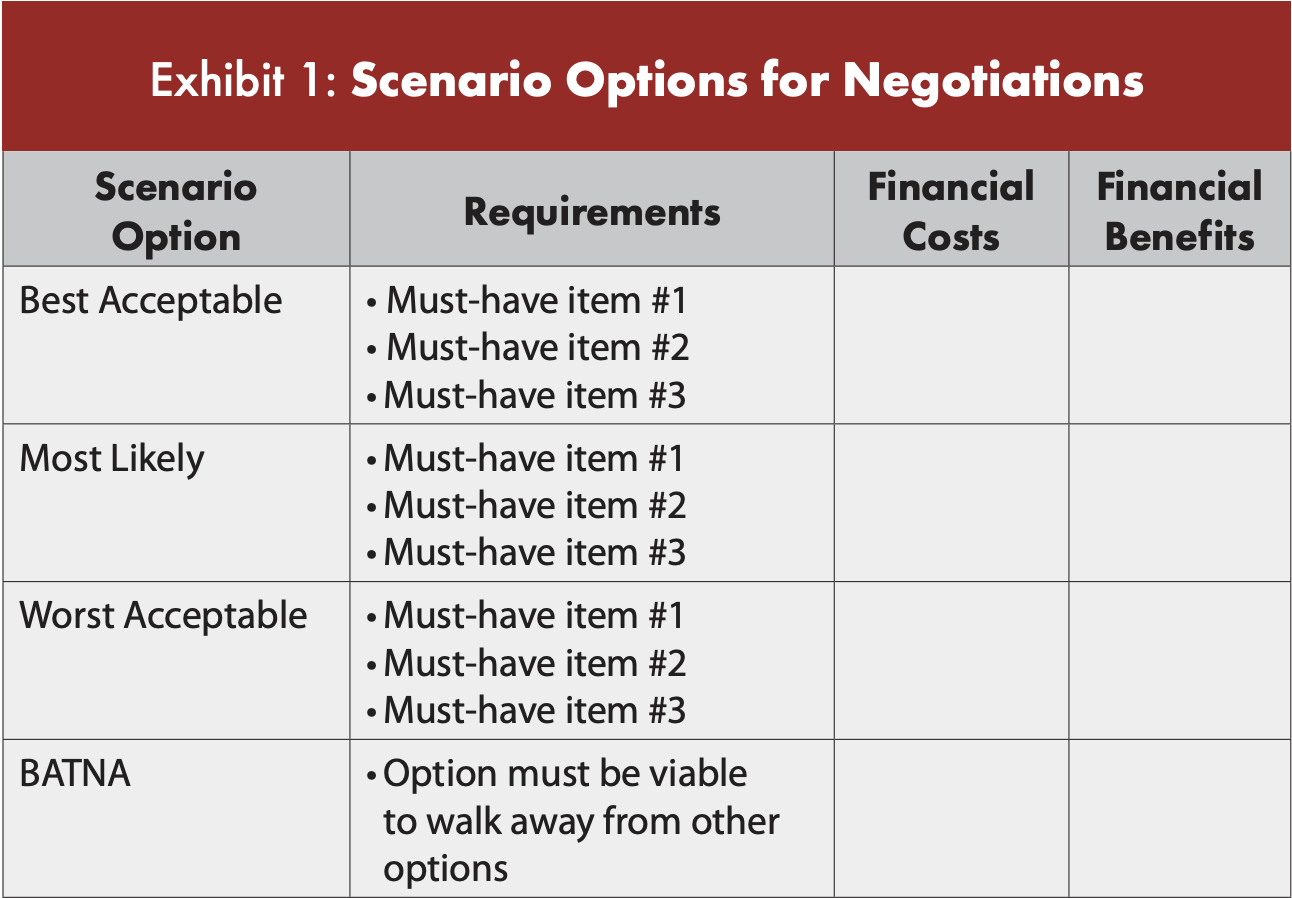
Even if you provide best- and worst-case scenarios, it is beneficial to give a third scenario, such as a “most probable” option, that falls somewhere between the two extremes. Extreme win/loss metrics might be challenging to navigate in negotiations, especially if they represent a broad range, so having the most probable option can help lessen the management of many options.
However, when a situation is “all or nothing,” a middle-of-the-road scenario is not applicable, and there is only one option. An example of this single option would occur if a company was renegotiating a supplier agreement with a sole source provider with no other options available.
Also, instead of thinking of your BATNA as an outside possibility that has no relation to the other party, consider the ramifications of saying “no” to the other side’s proposal. For the most part, how will these consequences affect your interests in a way that
CFMA Building Profits January/February 2022
is good for your company while bad for the other party? Consequences may include costs or risks that each party must bear, missed opportunities, altered settlement prospects, harm to the relationship, etc. Even though these are not outside options that are independent of the other party, they are still important.
When your party is at a disadvantage, consider how your side’s financial situation might improve with the benefit of additional cash flow or other factors if a completed agreement was delayed. With this, your BATNA may be to continue negotiations with the same counterpart while continuing to say no until your company’s standing has improved relative to the other party’s, rather than considering external choices that are independent of the other party.
Without a well-defined BATNA, you will be entering talks with a great deal of ambiguity. When facing uncertainty, hasty, misinformed judgments are more likely to be made. Some negotiators may be compelled to accept bargains because they believe there is no other option.
In contrast, others may leave negotiations prematurely, afraid to take any agreement since there may be a better alternative. Either way, the fear of what could have been will not linger as much if you decide to go through with the negotiated agreement.
If you choose to walk away, then your well-defined BATNA lets you know exactly where you will be going. Not only do BATNAs let you see where you are, but also where you want to go
January/February 2022 CFMA Building Profits
Check All Egos at the Door
Ego can be a common negotiator bias since most people exhibit a self-serving bias in their views and expectations. When given the same information, each person will interpret it differently based on their perspective. First, each will choose a favorable interpretation or result for themselves; then, they will defend that choice on the premise of fairness. To see oneself in the best possible light, people often change the prominence of the attributes that influence their fair assessment. Some are downplayed, while others are heightened.
Ego causes us to draw erroneous assumptions about the ethical behavior of the other negotiating party. Being unaware of an ego bias can inadvertently lead one party to become suspicious and distrust the other party. Most people generally assume that their opponent is trying to get the better of them during negotiation. When a request is made that is deemed outside the acceptable range, recognize the urge to immediately distrust the other party. The best solution is to treat the situation as if you were assessing it as an outside third party.
Carefully Listen to the Opposing Party
We have often seen teams come into negotiations with a script, and they wait for a break in the discussions to start their monologue. Understanding your own BATNA can only get you so far; you will also need to investigate the other party’s BATNA.
It is also possible to explicitly ask what the other party is considering, but be prepared for them to overestimate how strong the BATNA is for their company. Dealmakers who are well-versed in business strategy know that there are usually two BATNAs — that of the other company as well as one for the other individual(s) representing their BATNAs. (If the deal does not close, the BATNA for other individuals may be a different career.)
Ego causes us to draw erroneous assumptions about the ethical behavior of the other negotiating party. Being unaware of an ego bias can inadvertently lead one party to become suspicious and distrust the other party. Most people generally assume that their opponent is trying to get the better of them during negotiation. When a request is made that is deemed outside the acceptable range, recognize the urge to immediately distrust the other party. The best solution is to treat the situation as if you were assessing it as an outside third party.
See All the Risks Ahead of Time
Even when discussions are not progressing quickly, BATNA frequently comes into action. Consider the following basic, but not all that common, illustration of what is meant. Suppose you’re in the middle of discussions to resolve a business dispute when the other side refuses to move and insists that the only solution is a drastic one. To find solutions that satisfy all parties, go deeper to uncover underlying reasons. Conversations may come to a standstill if you determine your collaborative method does not work.
At some point, you may decide to hire lawyers and management consultants to build the business case and then sue the opposition — not only on the issue you are negotiating, but perhaps also on related ones to expand the scope and create an overarching deal. If you issue a warning or take legal action, you may be able to negotiate a better deal; you do not need to wait for a solution to your decision. Pre-negotiation preparation should include examining the legal choices that are open to each side.
When negotiating, the opposite side may use aggressive methods, such as intimidation, yelling, or pressuring your side to make a quick decision. Because these strategies work best when negotiators are caught off-guard or unprepared, being aware of your BATNA will help safeguard against these types of methods and give you a clear picture of your situation as well as the other party’s options.
If your opponent threatens to leave the negotiation, make it clear what steps you will take to put your BATNA into effect if the negotiation fails. As a bonus, you may demonstrate to your opponent that you want to continue negotiating even if you have reached an agreement from which you are willing to walk away.
Know When to Pull the Ripcord
Negotiations are all about timing, and BATNA should never be the last option.
Whether or not they specifically mention BATNAs, effective practitioners regularly emphasize to negotiators the significance of convincing the opposing party that you are ready and able to walk away from the negotiation (ideally to something appealing). As soon as the opposition senses your willingness to walk away, you have a much stronger negotiating position.
However, if you walk away, know that it is most likely over. If you return, your negotiating power can be substantially reduced, which is why creating your BATNA before negotiating is essential.
Do Not Show Your Hand
Developing a solid BATNA might be difficult no matter what you do. For example, it may not be possible to find another option that is equal to or more attractive than your current negotiations. Do not divulge a weak BATNA to the other party in such situations. Also, avoid appearing frantic or overly eager to close the deal.
CFMA Building Profits January/February 2022
In some negotiations, be aware that there is no BATNA option to take into account. These are must-have deals that, if not completed, will have disastrous effects on the business. These negotiators are tied to the other party’s company, so they have no choice but to reach an agreement. Other possibilities for fulfilling your interests without the other party’s cooperation are irrelevant in this situation. When these negotiations are completed, the chances are very likely that the two sides will remain together. To advise the other party to “go away” and then attempt to leave the business relationship may not be particularly effective to use in your BATNA.
Do not be deceived by the other party’s claims that your BATNA is not as strong as their option. Regardless of how strong your BATNA option is, if the opposing side learns about it, they will undoubtedly try to minimize its value. For example, we represented a company that was being bought in a competitive bidding situation. In an attempt to encourage our side to accept the other party’s offer, they tried to lower our client’s BATNA attractiveness by insulting the competing bidder and management team.
Focus on the Analytics
Though smooth talk and flattery may carry you far in the deal-making process, you’ll have to meet the other party’s substantive needs to reach a truly valuable deal. This means analyzing the various scenarios and examining the financial impact of each option or combination of options. These analyses and projections often extend into a multi-year model and identify downstream impacts from potential transactions, such as opportunities to acquire new businesses or markets. These analytics or financial impacts can typically yield a priority order of options to use as a cheat sheet during the negotiation process.
As Harry Callahan said in the movie “Magnum Force,” “A man’s got to know his limitations.” Have a plan in place when entering into negotiations — one where you know the financial limits to which you are willing to yield for terms of a deal. Mature and experienced negotiators look for compromises that provide value and know when to walk away from a transaction because of it.
Know Where the Exit Is
If you and your negotiator cannot come to terms, what are your best options? Even though BATNA is a well-known negotiating concept, approaching it in a structured way can help you reach the best possible conclusion, even if it means walking away from the table altogether.
n another negotiation, we represented a seller who was looking to retire, and the acquiring company knew there were no other offers to buy the company. They offered a deal that undervalued the company and minimized his accomplishments. What they did not know is the current owner’s management team had put together a BATNA plan for a management buyout of the current owner. With this knowledge, the owner walked away from negotiations to a prepackaged deal.
A clear understanding of your BATNA before negotiations might give you the needed assurance to head for the exit in a bad deal.
Everyone Wins
The idea of collaborating to generate opportunities for mutual benefit implies that both sides of the negotiation have objectives and restrictions that are unlikely to be similar. Negotiators frequently miss mutually advantageous agreements because they approach negotiations from an all-ornothing perspective.
In a tiny percentage of transactions and conflicts, negotiators are forced to focus only on a single subject — generally the price. Price is often a zero-sum game; however, this can be mitigated by creating a joint venture or an agreement containing shared risk (downside) and gainshare (upside) benefit clauses. With price or other issues, if your attention is drawn solely to a specific problem, then it might be challenging to identify methods to broaden the discussion and address other difficulties.
Final Thoughts
Focusing on one’s BATNA has many advantages, one of which is the habit of continuously asking, “as compared to what?” It is critical to emphasize that BATNA is frequently only applicable in discussions with respect to another specific party’s lowest acceptable offer. To ensure a successful negotiation where both sides are happy with the outcome, you must have this knowledge, or as much of it as feasible, before you begin. Negotiation involves knowing and understanding these issues and where each side stands on them. All of this suggests that you should know what your BATNA secret weapon is before entering into any negotiation.
CFMA Building Profits January/February 2022
Endnotes
1. Walker, Scott. “Reagan’s firing of striking air traffic controllers set the stage for his presidency.” The Washington Times. August 5, 2021. www. washingtontimes.com/news/2021/aug/5/reagans-firing-of-strikingair-traffic-controllers.
2. Ury, William & Fisher, Roger. Getting to Yes: Negotiating Agreement Without Giving In. Penguin. 1981.
3. “BATNA Basics: Boost Your Power at the Bargaining Table.” Program on Negotiation at Harvard Law School. Harvard University. 2012.
DAN DOYON is Director at Maxim Consulting Group (www.maximconsulting.com) and is based in Dallas, TX. He works with construction-related companies to solve complex business challenges to increase revenue and profitability. With his guidance, companies have driven over $160 billion in top-line sales growth and hundreds of millions in operational savings through improved processes. Dan specializes in business transformation and turnarounds, published research papers and trade articles, and is an acknowledged industry speaker. Dan received his MBA from Georgetown University. He can be reached at 325-320-9130 and dan.doyon@ maximconsulting.com.
MICHAEL McLIN is Managing Director at Maxim Consulting Group (www.maximconsulting.com) in Englewood, CO. Michael is responsible for leading the business and guiding the strategic direction. He works with construction-related firms of all sizes to evaluate business practices and assist with management challenges. Michael is a nationally recognized dynamic public speaker and published author. He can be reached at 303-898- 8440 and michael.mclin@maximconsulting.com
CFMA Building Profits January/February 2022
© 2026 Maxim Consulting Group. All Rights Reserved.
