BY CHRISTINE RAHLF
HOW KRAs DRIVE SUCCESSFUL
Employee Recruitment & Retention

BY CHRISTINE RAHLF
HOW KRAs DRIVE SUCCESSFUL
Employee Recruitment & Retention

With the recovering construction industry projecting an annual job growth rate of 2.6% through 2022,1 the shortage of qualified workers and increasing demand has created a candidate’s market. Employers will need to leverage every tool available to attract, hire, and retain the right people.
One effective recruitment tool is a Key Results Area (KRA) job description. This article will discuss the critical elements of a KRA and how it can help your company successfully identify, hire, and manage its employees.
selecting lower grade material that may compromise the quality of the installation.
• Scrap material. In some trades, it is considered standard practice for the field to collect and turn in demolished or scrap material for cash, which is then kept by the foreman or distributed among the crew. Unchecked, this practice can encourage deliberate damage or over-ordering of material. If the project is a cost-plus or time and materials project, the actual cost of the project to the owner can be impacted by this practice.
• Field labor tracking. Many of our field leaders are responsible for tracking crew time and preparing or reviewing time cards. How do we ensure that the time entered is valid and that work is being accomplished as reported?
• Out of scope work. Horse trading, for example. The performance of minor work items for either no cost, in-kind trade, or future consideration is common and sometimes a necessary part of project execution. When does this practice become undesirable and is that answer different for different projects or clients?
While there is no silver bullet that can address and control all possible ethical issues in the field, a company can significantly influence field behavior by intentionally addressing ethics in the recruitment and hiring process, project planning, execution standards and practices, and employee performance management.
CFMA Building Profits May/June 2015
• Perform financial checks on new customers
• Prepare monthly financial reports
• Manage bank relations
Many job descriptions list 25-50 activities and finish with the ubiquitous “and other duties as assigned.” A job description with a lengthy list of activities leaves candidates uncertain as to the position’s true priorities and how success will be measured once they are hired. An ambiguous job description can sabotage your hiring efforts and imply that your company doesn’t know what it needs.
Top candidates expect a potential employer to be confident in what skills and abilities are required for success. A detailed KRA job description provides candidates with a clear picture of the critical elements of the role, what activities support each element, and how success will be measured.
Developing KRA Descriptions
Developing KRA job descriptions for each role within a company can be a daunting task. One way to begin is to develop KRA job descriptions for current openings and then backfill descriptions for other roles by department. Let’s look at how to convert a traditional activity-based job description into a KRA job description:
1) Review the current job description’s list of activities and group them into 3-5 key areas.
2) Define KRAs based on these groupings.
3) Determine which activities can be measured and include these as supporting activities.
4) Develop accountabilities.
The most difficult part of this exercise is developing accountabilities. If you have difficulty with this task, then review the role to see if it is adequately defined with supporting activities.
If you don’t know what defines success for a particular role, then chances are a potential candidate won’t either. Every role should have clear accountabilities. Failing to provide a potential employee with a clear definition of success robs them of the opportunity to shine.
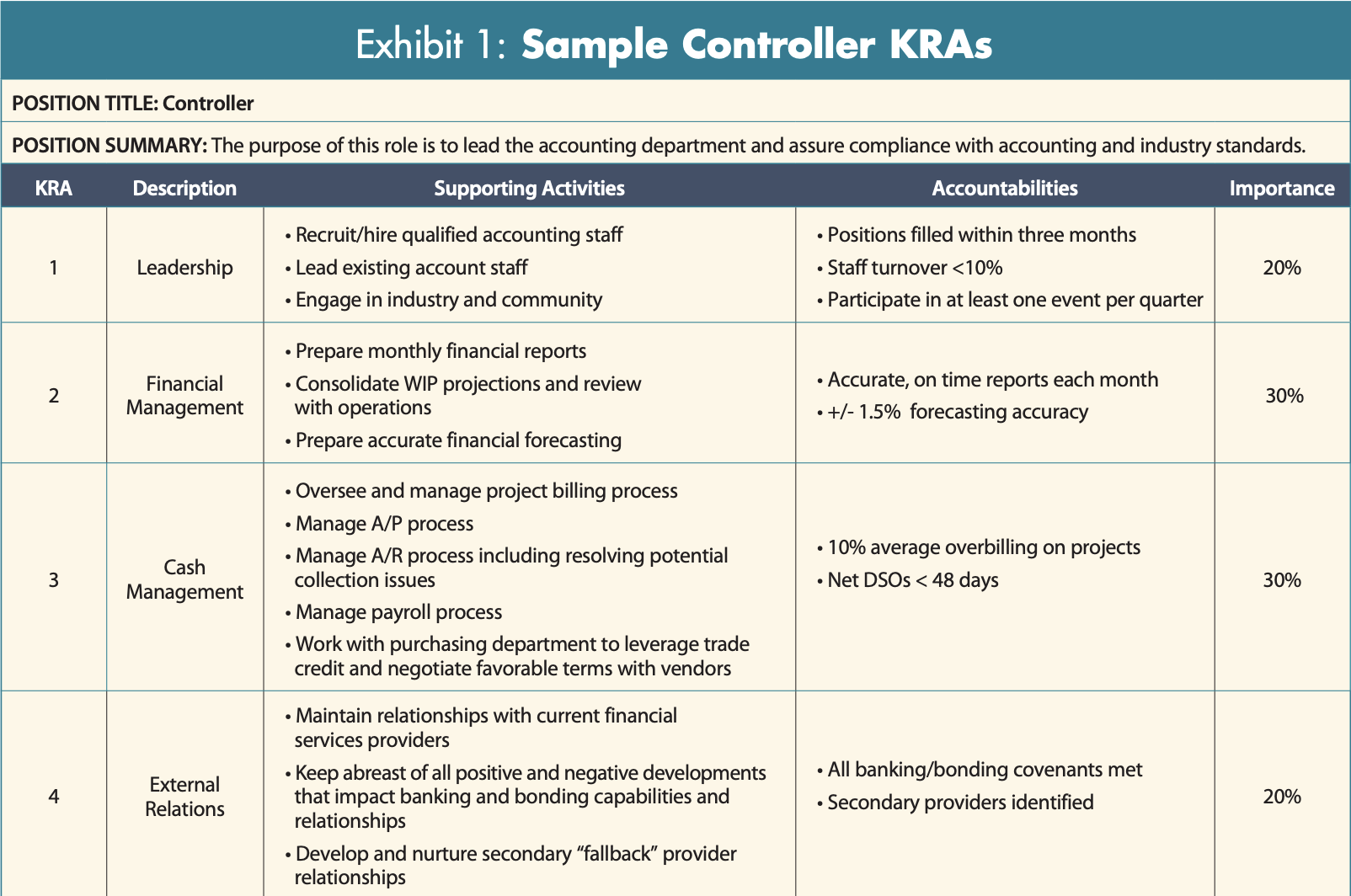
Returning to the previous controller example, the KRA job description for this position might look like Exhibit 1 on the following page.
KRAs & the Job Interview
Developing KRA job descriptions will pay off during the interview process. Hiring managers often struggle to develop relevant questions that accurately predict whether a candidate will excel in a particular job. As a result, they may resort to questions that are irrelevant (e.g., “Can you tell us about yourself?”) or leading (e.g., “Do you think customer service is important?”).
Discovering the Four Key Elements
In his book Hiring Talent, author and consultant Tom Foster proposes that interview questions should be based on discovering four key elements about the candidate:
1) Capability – Does the candidate have the aptitude for the job?
2) Skill – Does the candidate have the technical ability and actual experience to perform the job?
3) Interest – Is the candidate excited about the job?
4) Reasonable Behavior – Does the candidate have the necessary work habits (e.g., positive attitude, attention to detail) and is he or she absent of any negative habits that would prevent success?2
A good KRA job description serves as a roadmap for developing questions that can unearth these four elements. Past performance does predict future success. As an interviewer, learn if the candidate has experience achieving the key results that you seek.
For each KRA and associated activity, prepare a series of questions that explore the candidate’s capability, skill, interest, and reasonable behavior. Foster recommends developing at least 10 questions for each KRA, which will yield approximately 40-80 interview questions.3
Sample KRA Questions
Using our sample controller KRA, let’s focus on one result area, cash management. Here are some sample interview questions based on this KRA:
1) Accounts Receivable
a. Can you tell me about a time you managed A/R? (capability and skill)
b. What process did you use to track aging A/R? (capability and skill)
c. What process did you use to pursue collections? (capability and skill)
May/June 2015 CFMA Building Profits
d. What aspects of the A/R process do you find most enjoyable and most challenging? (interest)
e. Tell me about a time you had a disagreement with a customer. How did you handle that situation? (reasonable behavior)
2) Project Billings
a. Can you walk me through the billing process at your previous job? (capability and skill)
b. How did you motivate your team to ensure billings were done accurately and on time? (interest)
c. What measures did you take to ensure positive cash flow on major projects? (capability and skill)
d. What steps did you take when a project was underbilled or incorrectly billed? (reasonable behavior)
Each interview question is very specific and directly corresponds to one of the KRAs or its related tasks; such direct and role-specific questions as these will allow you to quickly gain an understanding of candidates’ skills and interests
and whether they are a good fit for the role. You will also be able to quickly identify gaps in experience that will either eliminate a candidate or indicate an area that will require additional training and development should you choose to hire him or her.
Another advantage to using KRA-based interview questions is that it creates an independent and unbiased basis for comparing candidates. By posing the same questions to each candidate, you can rate candidates in each KRA and weigh those ratings based on the relative importance of the KRA. This helps prevent basing a hiring decision on a personality bias toward a particular candidate or on experience in only one or two key areas.
KRAs & Performance Management
The number one reason employees have cited for leaving their jobs is “limited career or promotion opportunities.”4 But what that statistic doesn’t measure is the number of employees that remain at their jobs but disengage from their roles, unhappy and underperforming
CFMA Building Profits May/June 2015
kras drive successful
Recruitment & Retention
A DETAILED KRA JOB DESCRIPTION
provides candidates with a clear picture of the
critical elements of the role, what activities support
each element, and how success will be measured.
Ironically, many employers struggle to fill middle and senior management positions, seeking outside candidates in a tight labor market.
Companies must realize that in order to succeed, they need to grow their own leaders by identifying high potential candidates within the company and help them fulfill their potential by providing them with meaningful performance feedback, individual development goals, and career path mapping. The performance appraisal process is a key component that supports career development.
The Performance Appraisal
A company’s appraisal process is most effective when the appraisals tie directly to the KRAs of each role. Although many companies have KRA job descriptions, they still maintain just a handful of appraisal templates for broad employee categories (e.g., field, office, and supervisor). Criteria often used in such appraisals include quality, effort, and initiative. While these criteria are desirable, they are subjective and impossible to measure.
Instead of this one-size-fits-all approach, the appraisal process should begin by establishing and communicating to each employee their roles’ KRAs, tasks, and associated accountabilities that will be measured. It is important that both the employee and supervisor have a clear understanding of each KRA, how and when it will be measured, and what constitutes success.
For example, if you are hiring a new controller and one of the position’s critical goals is to improve cash flow, you should establish an upfront agreement about how it is measured (e.g., Days Sales Outstanding (DSOs)), how often it is measured (e.g., monthly), and the desired outcome and timing (e.g., DSOs < 45 days within six months of hire).
This ensures there will be no surprises during the performance review. Your controller will know exactly whether or not he or she has met the KRA accountability; it will not be a point of debate. During the face-to-face appraisal, you can have a meaningful conversation about performance improvement
steps if the KRA is not met, or set new goals and assign stretch projects if the accountability has been met or exceeded. Instead of focusing on justifying your ratings, you can focus on performance improvement and career development.
Career Growth & Retention
Establishing KRAs for all of your company’s positions also facilitates career path mapping for your high-potential employees. By comparing KRAs for an employee’s existing role to KRAs for the role he or she desires, you can identify knowledge and experience gaps and create a personal development plan for them. This personal development plan should include: • Goals – What are some of the identified gaps in skill and experience?
• Strategies – How are those goals going to be met?
• Resources – What people, material, and training courses are available?
• Measurement – How will completion of the goals be measured?
• Timeline – When will the goals be complete?
You may also want to establish stretch projects that test an employee’s capability to serve in a higher-level role. This gives the employee the chance to take on added responsibility without setting him or her up to fail with a premature promotion.
For example, if your staff accountant wishes to move up into the controller role, you may assign him or her a stretch project to improve a business unit’s cash position through leading a process improvement team focused on streamlining the billings and collections processes. You can even formalize this into a temporary KRA with specific due dates and metrics.
By utilizing KRAs to help create individual employee development plans and assigning stretch projects, you are recognizing the employee not only as a current contributor but also as an essential part of your company’s future. This is key to high potential employee retention.
May/June 2015 CFMA Building Profits
Providing employees with a roadmap to career progression within your organization helps deter them from searching for advancement opportunities outside your company.
Summary
KRA role descriptions are not the silver bullet that solves all of the challenges of employee recruitment, hiring, and retention. Developing and using KRAs as part of your performance management system takes time and commitment.
However, in a tight labor market where qualified candidates are hard to find and sometimes harder to keep, KRAs can be the tool that gives you the edge over your competition in the battle for top employees.
Endnotes
1. www.bls.gov/opub/mlr/2013/article/industry-employment-and-outputprojections-to-2022.htm.
2. Foster, Tom. Hiring Talent: Decoding Levels of Work in the Behavioral Interview. Foster Learning Corporation, 2013.
3. Ibid.
4. Branham, Leigh. The 7 Hidden Reasons Employees Leave. AMACON Books, 2005.
CHRISTINE RAHLF is an Associate Director at Maxim Consulting Group in Denver, CO. She works with construction-related firms of all sizes to evaluate business practices and assist with management challenges. Christine has extensive experience in both the government and private industry, where she has managed complex projects and led technical teams to successful results. Her areas of specialization include productivity improvement, process reengineering, scheduling, cost control, risk analysis, and training.
Christine is also an experienced operations manager and has led several companies through successful redesign and retooling of their operations departments to meet growth projections and market challenges.
Phone: 920-858-2350
E-Mail: christine.rahlf@maximconsulting.com
Website: www.maximconsulting.com
CFMA Building Profits May/June 2015
© 2026 Maxim Consulting Group. All Rights Reserved.
