BY STEPHANE McSHANE

BY STEPHANE McSHANE
In the past, developing the culture of an organization – i.e., the social order and norms as to what is encouraged, discouraged, accepted, or rejected – was not a high priority when compared to business development, operational efficiency, and profitability.
Today, cultural impact has shifted to the forefront, with companies investing energy in aligning culture with employees’ personal values, drives, and needs. When aligned properly with corporate strategy and leadership, culture can unleash constructive energy toward operational excellence. Employees of small to medium-sized companies often worry that company growth means losing the family feel of a smaller organization.
While this preconceived notion of a cold, corporate environment may cause anxiety, growth does not automatically mean the decline of positive culture. However, it does force a discussion about creating a path to not only preserve company culture, but to also improve it.
Construction employees’ expectations are beginning to demand an improvement in culture. The beliefs and behaviors influencing how employees and leadership interact with both internal and external customers sharply affect how business decisions are made and, by extension, the company’s reputation. When implemented and nurtured correctly, culture holds employees accountable to the core values of a company, creating a positivity that each team member strives to emulate.
Accepting that a strong culture is important kicks off a complex, yet essential, endeavor. Within the next seven years, the population of Millennials in the workforce will likely exceed 75%. The demands of this generation differ widely from previous generations in their need for feedback and desire over control of their professional growth, requiring a culture that is vastly different from what many companies currently have
in place. Some of the key components of cultural evaluation and implementation are discussed below.
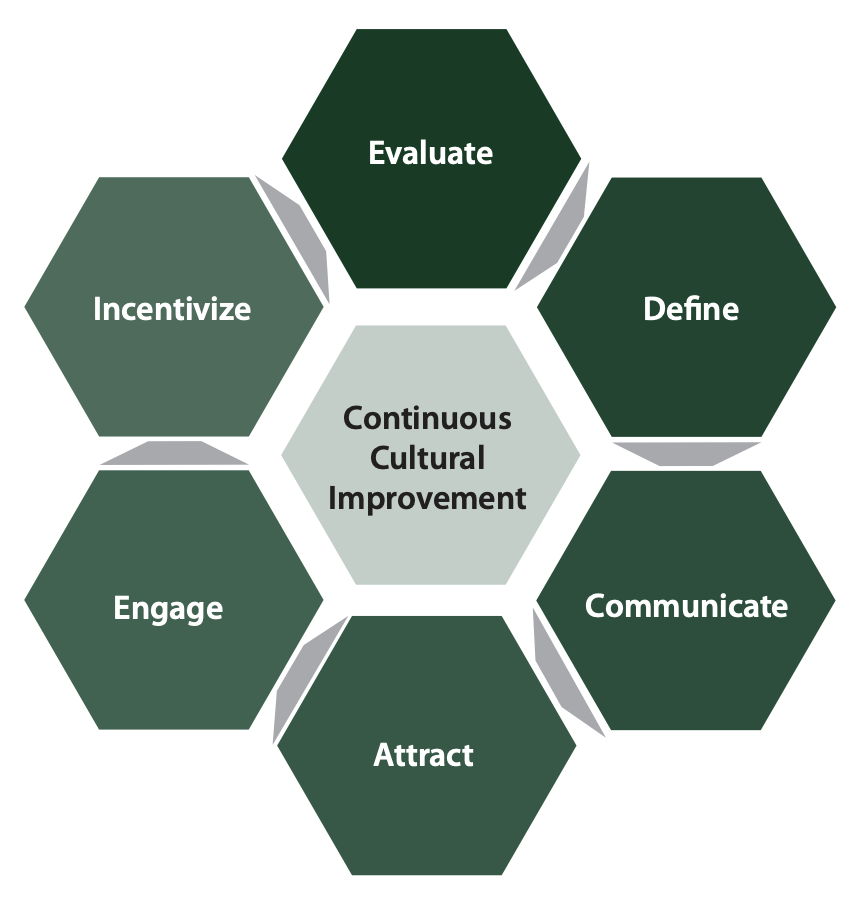
Evaluate the Current State
As with any type of business process improvement, a comprehensive evaluation of the current state is important to procure. While an evaluation of culture may seem daunting, there are several important sources of information to consider. What is the mission or vision statement of the company? Can your employees cite these or the core values when asked? If they can, consider this a step in the right direction. If your employees are already practicing them, you’ve already made great strides.
In most organizations though, the staff is unaware of mission, vision, and values statements. Instead of these statements representing the company as a mantra by which it lives, they merely become empty words on paper.
Current leadership culture can be determined by using evaluation tools for qualitative and quantitative review of company leaders from the perspective of superiors, peers, subordinates, and even vendors and customers. Also, performing exit interviews for both voluntary and involuntary separations from the company, followed by root cause analysis to establish patterns of turnover, helps to analyze culture from within. Additionally, one of the most effective methods of determining culture is to have open, honest conversations with employees and gather opinions on company culture.
During the assessment phase, care should be taken to recognize that an employee’s perception of the company’s culture is how they really feel, regardless of how the leadership perceives it. If gaps exist, it is necessary to commit to change and follow through. Anything less would break trust and confidence in the leadership of the organization and could harm team performance.
The Continuous Improvement Cycle
CFMA Building Profits May/June 2019
Define Cultural Best Practices
If a company determines that its culture is need of improvement, take steps necessary to ensure it does not become a top-down initiative. If implemented from the executive level down, it may be perceived as “an order” instead of a desired collaborative effort. Although one could argue that culture is lead from the top, determining the needs or wants of the employees should never be assumed.
If clarification of the mission, vision, and values of the company is needed to ground and center the culture initiative, then a team representing multiple work groups from field leadership through executive management would be best equipped at determining the most desired and relevant core values. The opinions of all focus group members should be taken into consideration, ensuring that there is adequate discussion and process documentation.
Communicate & Publicize
Once an agreement has been reached, the effort can then shift to communicating the culture and utilizing the subject matter experts who were involved in casting of the new “normal.” This method allows for highly effective peer-to-peer training to take place as the next step, which is also a priority for Millennials. When training and mentoring begins, subject matter experts should introduce why the initiative has been given such importance, who was involved in casting the new definitions, and how each employee plays a role in the support, mentoring, and accountability of others.
Many companies are turning to promotional videos to discuss company culture, allowing clarity behind such initiatives to come to life. Employees are able to see that staff at all levels were involved, ensuring that their opinions and ideas were considered, and that leadership is not only behind the initiative, but is wholeheartedly endorsing it. Videos can also be used in the recruitment and hiring process, as culture is a key element of potential employees’ decision-making.
Additionally, the mission, vision, and values statements must become a large part of the working mantra. They should be displayed around the office and at jobsites, mentioned regularly in meetings and company gatherings, and serve as company values when interacting both internally and externally. This is how leadership can practice what they preach and set the example for all to follow.
Attracting Employees
Culture plays a larger part in attracting employees than ever before. Young, prospective employees are looking for work
CFMA Building Profits March/April 2019
in place. Some of the key components of cultural evaluation and implementation are discussed below.
Evaluate the Current State
flexibility, challenge, perks, authority, upward mobility, and control over their careers. In addition to utilizing an emotional model of culture, it is important to consider how the work environment contributes to this as well.
Many contractors are following suit from the technology industry by renovating or building new facilities. Beautiful office spaces, large meeting rooms for gatherings and training events, small meeting rooms for mentoring or small training sessions, gymnasiums, locker rooms, a well-equipped kitchen, and spacious break areas inside and out are all important to prospective employees.
Additionally, many companies have invested in structured wellness programs, exercise programs, and catered health foods for breakfast, snacks, and lunch. While these types of perks may seem expensive, the state of the market and the generational workforce shift may define them as necessary.
Engaging & Retaining Employees
Once a new employee is on board, retaining them will be necessary to prevent excessive turnover, especially given the mindset of a generation that tends to be nomadic in nature. The onboarding process typically has a high turnover rate due to a lack of any formal process to address the skill sets required for the position, and the absence of any mentoring program aiding in the cultural and social assimilation into the company.
Effective training and mentoring in the form of video instruction, group training, flowcharts, and desk level instructions can take the place of the antiquated method of bringing someone in, piling on the work, and hoping they can learn fast enough to keep up.
Additionally, employee engagement discussions have taken center stage as employees want control over the direction and timeline of their career advancement. Career path mapping and employee engagement surveys have helped open up the previously taboo discussion around an employee’s career trajectory within an organization, no longer waiting silently while hoping for a promotion or raise. Employees are playing a more active role in their own career development, so creating and implementing tools to manage, capture, and facilitate staff development is key.
Roles and responsibilities should be defined so there are standards for not only who does the work, but also how the work gets done. This provides an effective organizational structure that clearly depicts vertical employment opportunities as well as lateral changes available. Keeping the lines of communica
Strategy
tion open during career path mapping helps the employee play an active role in their own career development within the organization, instead of looking externally to make a move.
Transparency
Owners and executives used to be hesitant to share project financials with project management staff, or labor information with field leaders, with lack of transparency behind individual performance being an additional concern.
However, more companies today are taking transparency to a whole new level. By allowing employees the ability to evaluate key results areas classified by job title, they can ensure that the employee understands the expectations of the position, as well as the tools to be utilized to evaluate effectiveness. It also allows a collaborative environment where they can evaluate key skill sets needed for the position and whether the employee has received training, can perform the task but with supervision, can perform the task independently, or is skilled enough to become a certified trainer.
Technology now plays a huge role in allowing transparency of performance in real time. Implementing platforms that allow immediate entry or updating of electronic drawings, schedules, short interval plans, time entry, quantity tracking, job cost reports, labor productivity reports, purchase orders, and subcontract agreements will be expected by the next generation.
A project manager should have dashboards and automated reporting to look for important exceptions, flagging or e-mailing those exceptions with ease, creating a lean solution to a previously time-consuming set of tasks.
The field leader should have the ability to plan and schedule their work, and have that plan be immediately available to the internal stakeholders responsible for ensuring that the correct tools, information, and materials are on site when needed. They, too, should have dashboards that look for the exceptions in the work, such as lagging field productivity, and flag or e-mail those exceptions.
If technology is implemented correctly and data is accurate, staff should no longer spend inordinate amounts of time looking for the problems.
Attracting Employees
Culture plays a larger part in attracting employees than ever before. Young, prospective employees are looking for work
Incentivizing Behavior
Now that the roles and responsibilities of a position are clear, the key results measured, the skill sets evaluated, and technology in place allows for a transferable and scalable operation, the discussion surrounding incentives should take place. Transformational organizations are exploring many different types of incentives in order to give focus and reward for desired behaviors. Incentives can be based on financial targets, mission, vision, and values statements within the company.
Implemented well, incentives can create a significant cultural influence and positions such as mentor, leader, motivator, and brand ambassador become additional compensable items. Creating a loop between culture, expectations, performance, and incentives provides a platform for high functioning teams and individuals alike.
Summary
Preserving or improving culture as your company grows can be a challenge. While you work hard to develop business processes and systems that help your company financially, it is just as important to ensure that its culture has been given the same attention. It is essential to engage with and commit to positive culture to ensure your processes deliver the level of performance that successful construction companies seek.
The good news? Culture is a completely scalable asset and the leaders within your company directly influence it. By listening to your employees, defining a strong set of core values, and then implementing them throughout all levels of the organization, you are creating an environment where a positive company culture can thrive and endure, no matter what growth takes place.
STEPHANE McSHANE is a Director at Maxim Consulting Group in Denver, CO, where she is responsible for the evaluation and implementation processes with the company’s clients. Stephane works with construction related firms to evaluate business practices and assist with management challenges. A previous author for CFMA Building Profits, Stephane has presented at numerous engagements for ASA, ABC, NECA, SMACNA, and others.
Phone: 303-688-0503
E-Mail: stephane.mcshane@maximconsulting.com
Website: www.maximconsulting.com
CFMA Building Profits March/April 2019
© 2026 Maxim Consulting Group. All Rights Reserved.
