

WWW.ASAONLINE.COM JUNE 2019
Converging Technology: Creating a Long-Term IT Strategy that Unifies Your Company
bySteve Antill, VP ofBusiness Development, Foundation Software
LEGALLY SPEAKING The Increasing Use of Drones in Construction and Related Issues
by Jim Sienicki and Ed Hermes, Snell & Wilmer LL.P.
Teamwork & Technology-The Business Strategies Case Study
by Stephane McShane, Director at Maxim Consulting Grouр
No More Field Paperwork!
by Chris Kinghorn, Partner, DataStreet
Drone Services for Efficiency and Cost Savings
by David Dengler, licensed FAA 107 UAV UAS (drone) pilot
3D Laser Scanning for Accurate Existing Conditions
by Garrett Maldoon, Kelar Pacific
Mastering Material Takeoffs Using Digital Methods
by Lindsay Powers, VP of Marketing, STACK ConstructionTechnologies
Propelling Risk Management Success through Pilot Programs
by Dave Galbraith, MS, AIM, CSP Amerisure AVP of Risk Management, Risk Management Technical Lead


by Stephane McShane, Director at Maxim Consulting Group
With the surge in technology deployment in our industry today, an opportunity exists to leverage these tools in order to strengthen the communication and engagement of the project team. The ability to quickly and easily share information that allows for accurate performance metrics, as well as risk mitigation, will become critical moving forward. Best in class firms are not just exploring which platforms to utilize, but how to best implement these solutions to create the greatest benefit. In this article, we will explore a case study of risk mitigation as it relates to loss of labor productivity.
All too often, we are impacted in our work on the jobsite. Other trades slow our progress, the schedule is incorrect forcing inaccurate planning, trades are stacked causing inefficiency. There are a multitude of reasons this occurs. The challenge lies in the ability to effectively prove an impact to create an opportunity for appropriate compensation. Proving this takes two parties: The office and the field. In order to increase your chances of recovering damages for these types of impacts, there are several steps necessary. In this case study, we will show that proving this case will require:
• Creation of a constructible budget
• Diligent use of short interval planning tool
• Accurate reporting of time
• Accurate reporting of quantities installed
• Comprehensive use of daily project reports
• Mining of data to create production information
Understanding the Budget
First and foremost, the team who is responsible for building the project, specifically the project manager and field leader, must come to consensus on what the budget should be. The budget should be in alignment with the means and methods of how a project will be built and should contain both hours and quantities. This would require a fairly extensive preconstruction planning process, but is well worth the investment of time to ensure that the team who is building the job has the right budget, and is well prepared to execute. Everyone on the team must understand the description, quantities, hours, and unit of measure for each budget item. Organizations should have well-established standard cost codes and work breakdown structures to ensure a process that can be replicated and compared area to area and job to job. This budget should be housed in the project accounting software so that, as change orders are
issued, the budgets can be immediately updated with both quantities and hours. Figure 1 is an example of a portion of a project budget.
Creating a Plan
A short interval plan, or 3-week lookahead (Figure 2), is one of the most powerful communication tools that exist in our industry. That said, it is one of the most poorly deployed. The premise behind a look-ahead is the ability for the field leader to tell us which activities are being worked on according to the GC or owner’s schedule, how many people will be working on each activity, the source and status of the material required for each activity, the status of the tools and equipment needed for each item, and quantifiable production targets for the field leaders given the proposed man loads. The ability to leverage a technology tool that allows for ease of entry by the field leader in order to minimize frustration is paramount. It also allows for ease of viewing by the remainder of the project team to ensure that any obstacles that exist between the field leader and his plan can be quickly resolved in a proactive manner, allowing for increased field productivity. The use of a technology platform allows for changes to be made to the plan from anywhere in the
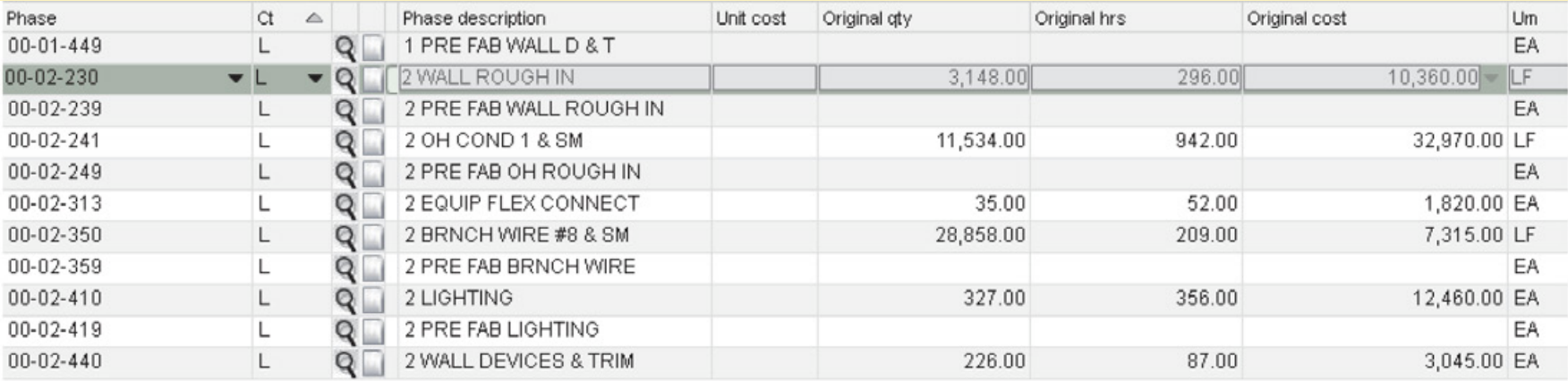
Figure 1
JUNE 2019 THE CONTRACTOR’S COMPASS
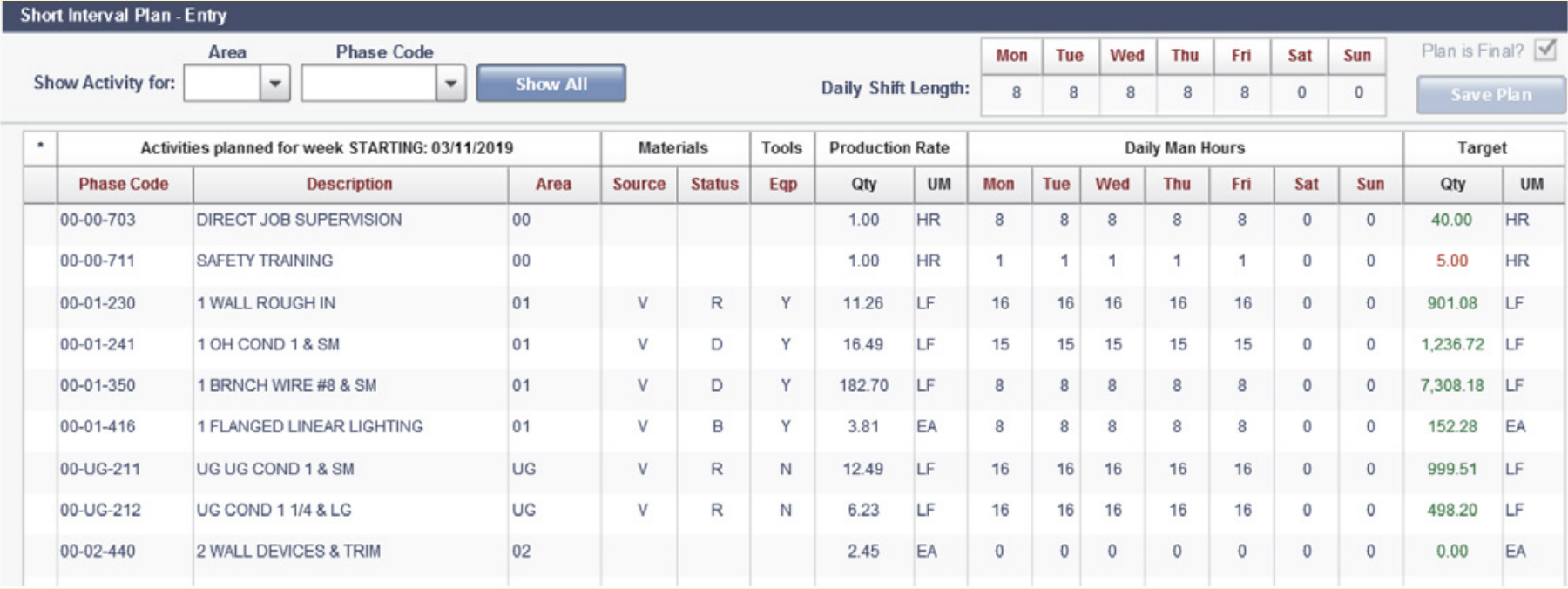
Figure 2
field, allowing the foreman or superintendent to revise the plan when changes occur, not having to rely on remembering to change it later.
Time Reporting
The use of a solid technology tool to capture time reporting creates several positive opportunities. First, it creates visibility of whether time IS being reported daily, as the level of accuracy required is high. Additionally, it allows for speed and accuracy since only the cost codes that have a budget and are active should be shown as open and available to report time to, lessening the chance of misreporting. Lastly, the use of technology allows for our tech savvy emerging leaders to complete this entry
anywhere, anytime via apps, tablets, or laptop. Figure 3 is an example of a technology solution built for this type of daily entry.
Quantity Reporting
For most trades, updating the quantities installed, or percent complete, on a weekly basis is frequent enough to keep a handle on medium to large construction projects. Some trades, such as sheetrock and framing, would tend to enter quantities daily due to the short duration and large manpower allocation to their activities. The reporting of quantities allows us to see whether we hit the week’s production targets, which is highly useful to both field leaders and project managers. Additionally
by comparing the planned activities to those reported on timecards and quantity reports, we can identify those activities that we worked on that were not planned. This is a critical step in risk mitigation. In the example on the next page (Figure4), there are some items that have a description that is in italicized type. Those activities did not appear on our short interval plan. By the use of reporting and data mining, we can identify any time our unplanned activities exceeded a predetermined threshold, spurring the ability to investigate the cause and send notification of impact in a timely fashion.
Daily Project Reporting
When we think about the most credible piece of documentation that exists
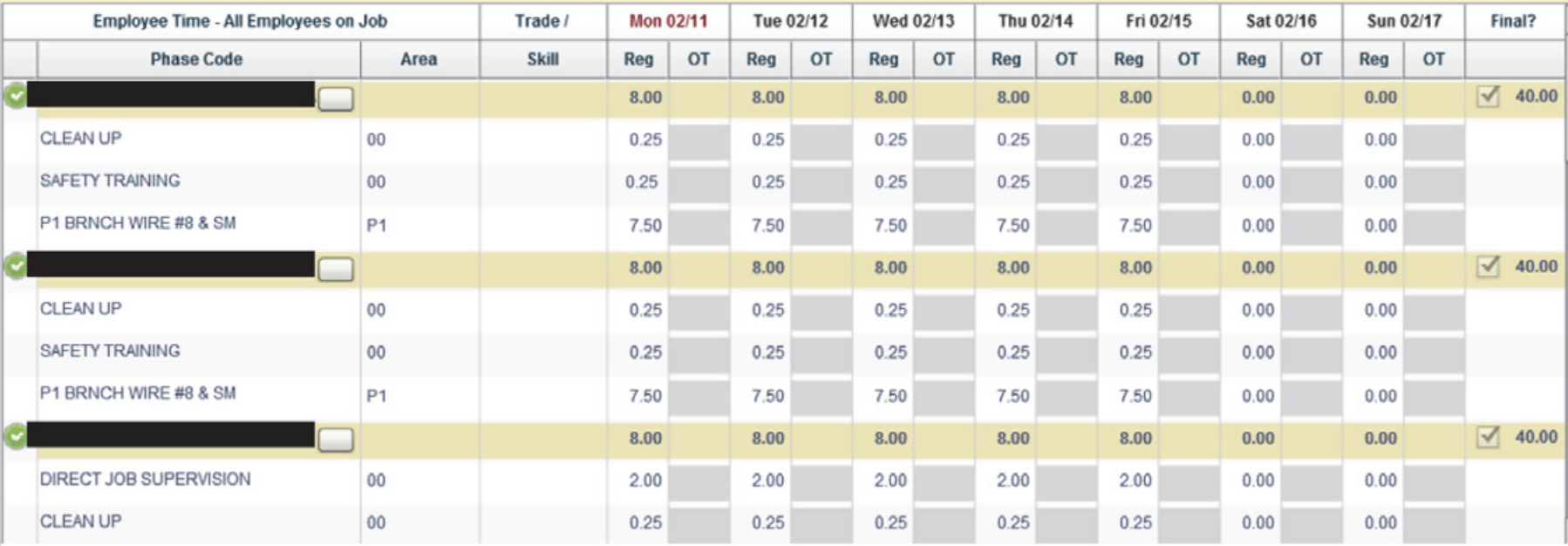
Figure 3
JUNE 2019 THE CONTRACTOR’S COMPASS
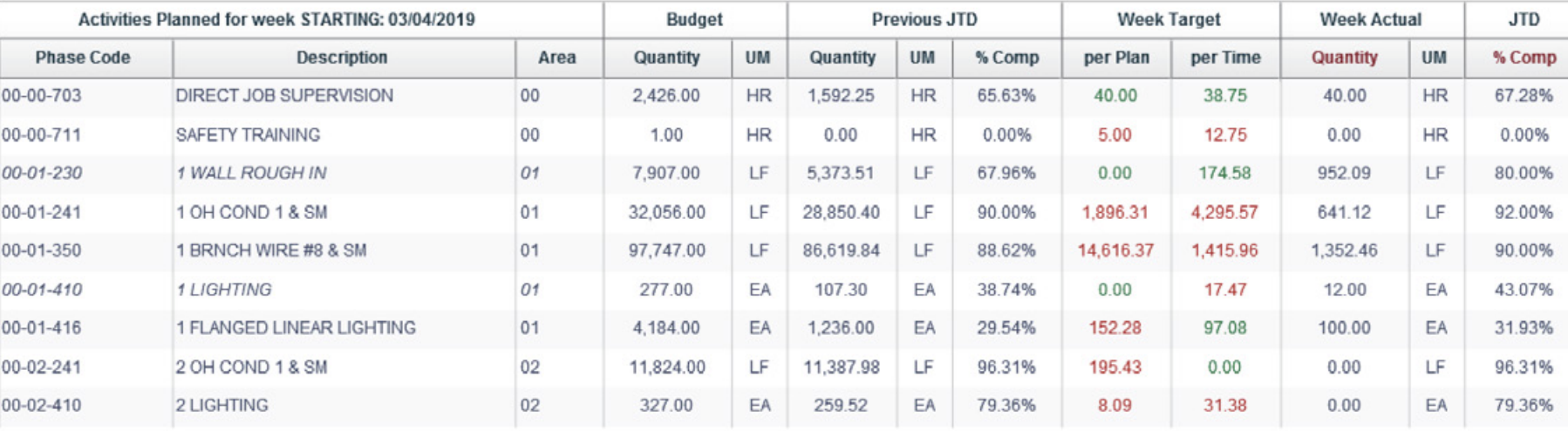
Figure 4
to prove an impact to our work, none exceeds that of the field leader’s daily project report (Figure 5). It is the piece of documentation done by the person closest to the work that tells the story of the project. It documents what happens, on a daily basis. That said, it isn’t always done consistently, or comprehensively. The use of a technology tool allows for visibility on its completion, as well as the ability
to mine this information at a later time. Some technology platforms also allow for the attachment of photographs specific to each section of the daily project report, which is a very valuable function.
Production Dashboards
Production dashboards allow the field leader to have a metric on labor productivity that is updated with each labor and
quantity entry they perform. The use of technology allows them to see the job including all cost codes, as in the example below, or they can sort the data by building, floor, or even a single activity. Translating information into a graphical format allows for our field leaders to identify those areas that are ahead in productivity, and those that are behind in a very quick and easy manner. For the
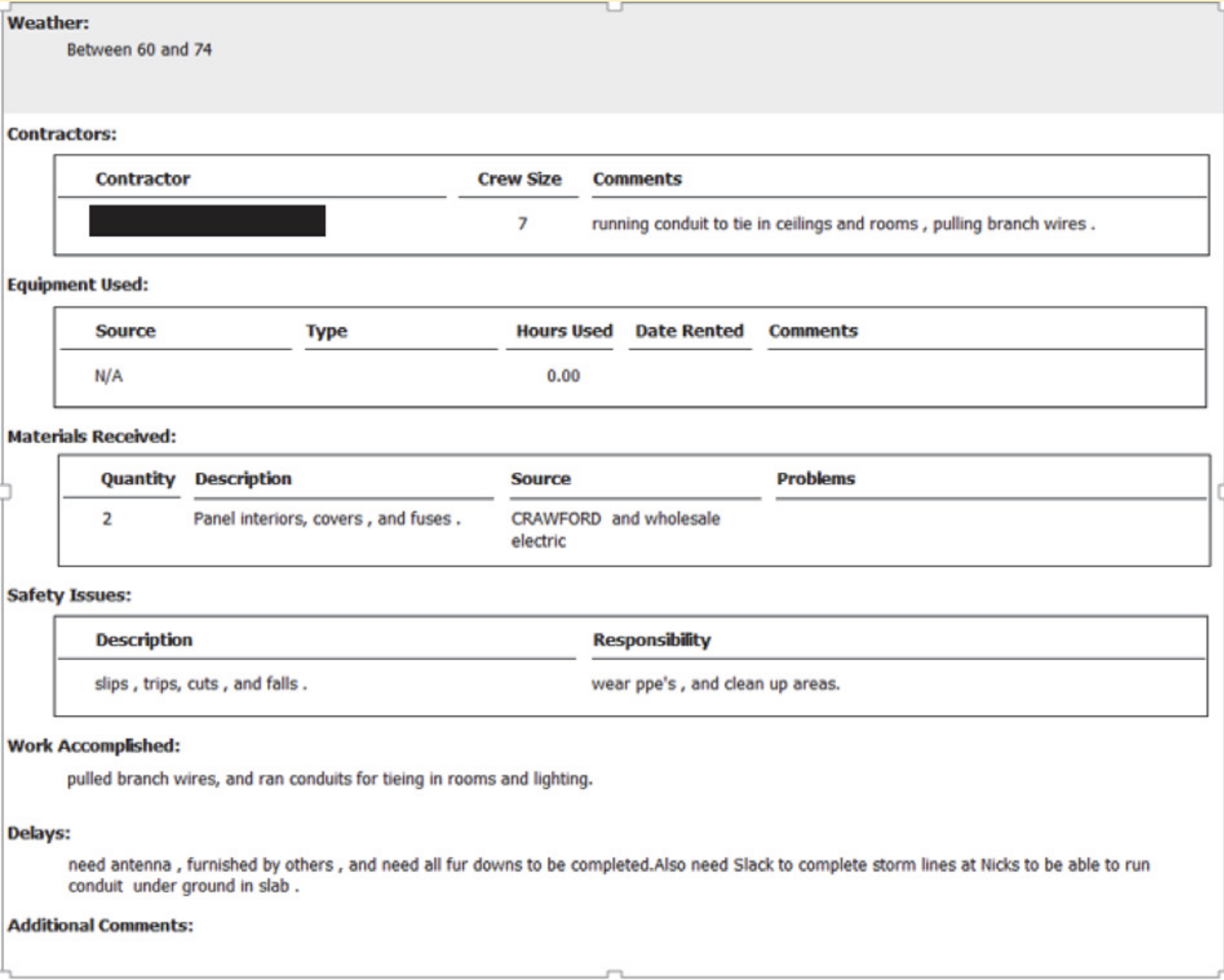
Figure 5
JUNE 2019 THE CONTRACTOR’S COMPASS
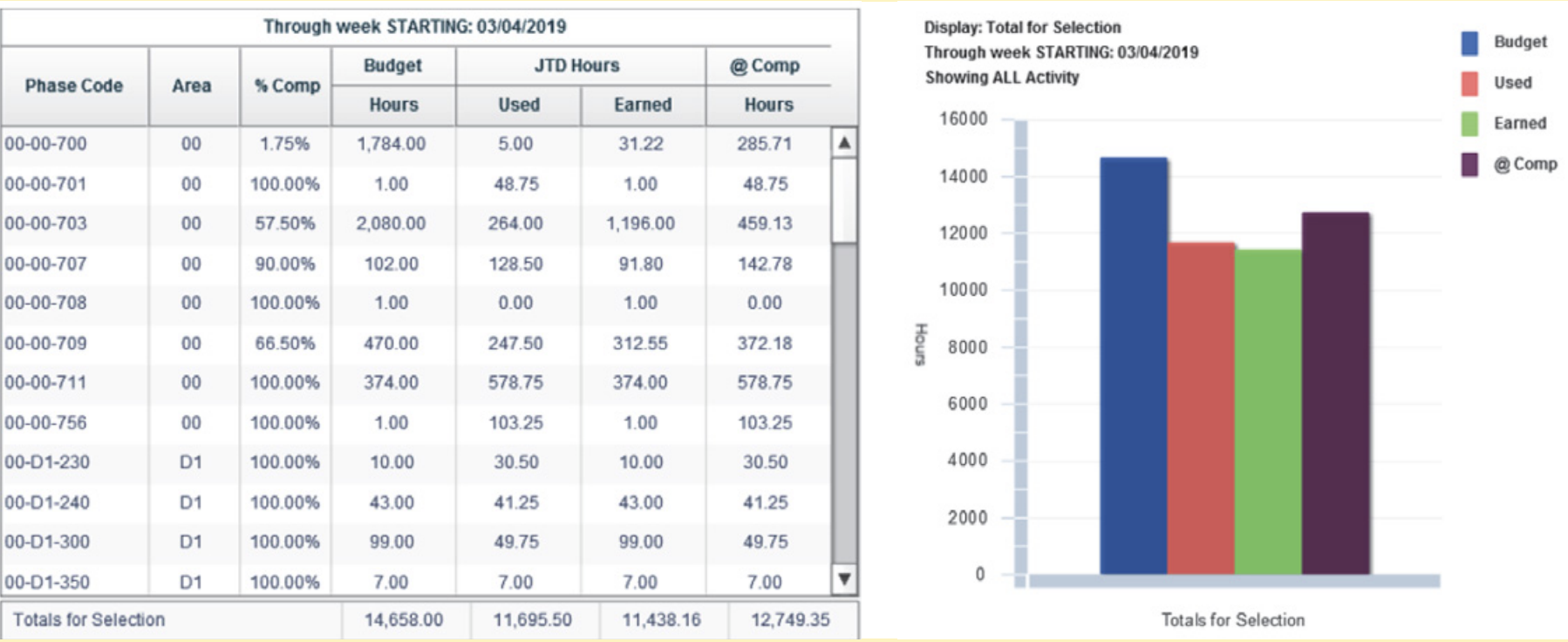
Figure 6
project manager, it allows visibility on the labor forecast for each labor item, given the current production rate of that item to date. This is powerful information for both field leaders and project managers.
Production Reports
Production information utilizing technology integration allows for us to view production information for any given payroll week, or any given phase code easily in order to compile data for an impact claim. In the example (Figure 6), this is a summary of the activities in a specific area that were heavily impacted by external causes. It is easy to see what the budgeted hours were, and compare them to what we used (taken from time reporting) versus what we should have used (calculated from quantity or percent complete reporting). The conditional formatting in reports allows the eye to be drawn to exactly the data we wish for project managers and field leaders to view, without them having to read all of the data to determine where to focus their attention. Additionally, this will allow us to accurately quantify the impact of loss of productivity. In this example, we should have spent 530 hours, but we actually spent 614.5 hours.
The Challenges
Historically, we have seen many examples of the, “us versus them,” mentality. Meaning, the field versus the office. Adversarial relationships were more frequent in the past as the two parties felt very independent of one another, and were angered when one stepped into the world of another with direction or dictatorship. Using the example of a project manager and a field leader, it’s devastating to see an uncommunicative relationship between these parties due to the necessary nature of their codependent workflow. The effectiveness of a project manager, at its simplest form, is steeped in the measurement of margin (profit) gain or fade. The effectiveness of a field leader, taking this same approach, is measured by productivity. However, each of these parties CANNOT reach the epitome of success without the other.
The Results
The case study noted above allows this client to effectively mitigate the risk associated with a project that was not going well, due to no fault of their own. Their ability to quantify the impact utilizing the processes they had defined, along with proper notification, allowed for significantly higher recovery of damages than they would have received without this data. The use of teamwork and technology to create a culture of effective
communication, proactive planning, and data centric production tracking allows not only for our own forces to foresee challenges in a project early enough to effect a change in the outcome, but also allows for the compilation of quantifiable evidence of an impact. The teamwork allows for great communication to occur. The technology allows for ease of use and speed of information sharing. The first step of any technology implementation is a comprehensive definition of what information is needed, in what format, by each position in the organization. Then, and only then, can the right technology be identified and deployed to give each and every person on your team the information they need to be project leaders, and not project witnesses.
Stephane McShane, Director at Maxim Consulting Group, is responsible for the evaluation and implementation processes with our clients. With a large depth of experience working in the construction industry, Stephane is keenly aware of the business and, most specifically, operational challenges firms face. Her areas of expertise include: Leadership development, organizational assessments, strategic planning, project execution, business development, productivity improvement, and training programs. For more information visit www.maximconsulting.com
JUNE 2019 THE CONTRACTOR’S COMPASS
© 2026 Maxim Consulting Group. All Rights Reserved.
