

Acquisitions enable companies to make significant growth in revenue, market, location, technology, and profitability in a short period and at a lot lower risk than long-term organic investments. Despite these benefits, tales abound of businesses that have made poor acquisition decisions. When committing cash and resources to the lengthy identification and due diligence of a potential acquisition, it is essential to have a high confidence level in the initial target selection.
CFMA Building Profits September/October 2021
Even if an acquisition is not completed, this process comes at a considerable expense. While extensive resources are available on the due diligence process, the early selection process remains somewhat of a mystery. This second installment of a three-part series on M&A1 will demystify the processes and criteria with best practices to help identify potential acquisition targets.
Strategic Acquisition Targets
When looking for strategic acquisitions, targets can fall into two major categories: associated with the original business or independent from the initial business to diversify the company.
Associated With the Original Business
Associated acquisitions are typically when a company acquires a new service business to leverage its current capabilities or add functional abilities, additional skills, or resources to its existing teams and services. These acquisitions are generally most helpful to companies with a robust current market share and a desire to provide complementary services to clients or expand into new markets. This could include an electrical contractor purchasing a mechanical contractor to provide additional value “bundled” services to clients or buying to expand geographical coverage.
Independent From the Initial Business
In comparison, independent acquisitions involve introducing businesses with distinct service markets or critical success criteria to those that are not connected
MERGERS & ACQUISITIONS
Identifying Strategic Acquisition Targets
to the company’s existing operations. These “independent” companies may have active corporate management oversight involved in the day-to-day operations or may have the corporate parent participate in company strategy, investment decisions, or shared services.
Developing an Acquisition Strategy
The selection of an acquisition strategy is primarily settled on by determining the path that best uses the acquiring company’s current management team and line-of-business managers. When a business has excess functional skills and resources relevant to its type of work, it should evaluate “associated” acquisitions as a viable strategic target.
Alternatively, a company can capitalize on the potential benefits of unrelated acquisitions if it has the ability and capability to:
• Manage a diverse set of businesses;
• Accommodate different company cultures under one corporate umbrella; and
• Leverage the management and financial resources and utilize economies of scale for shared services.
Evaluation Process
A company should establish a detailed evaluation process for selecting acquisition targets with the most significant potential to provide value to the acquiring company. Economic value is created only when acquisitions result in an increase of a combined company’s cash flow. Successful acquisition identification and screening processes primarily:
1) Contain an objective metrics-based ranking to assess the target company’s ability to generate value for the acquiring company.
2) Are relatively simple to implement and use when identifying potential target acquisitions.
3) Have the capability of reflecting the unique business aspects of any company to “normalize” against other target companies in a like-for-like manner.
Alignment With Company Strategic Goals
A company’s target acquisition evaluation process should be tailored to its unique strategic objectives. For instance, as a part of its strategy, a company that is flush with cash and anticipates significant capital investment requirements in four years may have to invest a portion of their profits into an acquisition to purchase the company. The acquired company should be financially self-sufficient and produce positive cash flow to address company requirements. This strategy lays out
a high-level plan for acquisition, a timeline for a return, and the use of the proceeds.
Specifying the worth of each measure spurs managers to examine the acquisition as part of a larger plan for company objectives, available resources, and employee skill sets. Developing these steps as part of a strategic plan may customize general principles frequently found in a target acquisition evaluation process matrix. A statement may even be needed for each metric evaluated as part of the process to define the minimum or maximum value tolerance. For purchasing companies, these metric rating ranges will represent the importance of each issue.
Metrics-Based Ranking
A best practice technique is to rank potential acquisition targets based on metrics. The strategic goals of the acquiring business are achieved by target company performance. Setting clear objectives is crucial to measure it, but aligning the company’s leadership is also vital for making a purchase. After aligning with company strategic goals, financial metrics are the second most critical component to evaluate a potential acquisition and calculate the estimated economic benefits of the purchase. It has been demonstrated many times that experience in M&A leads to higher rates of success in investments.
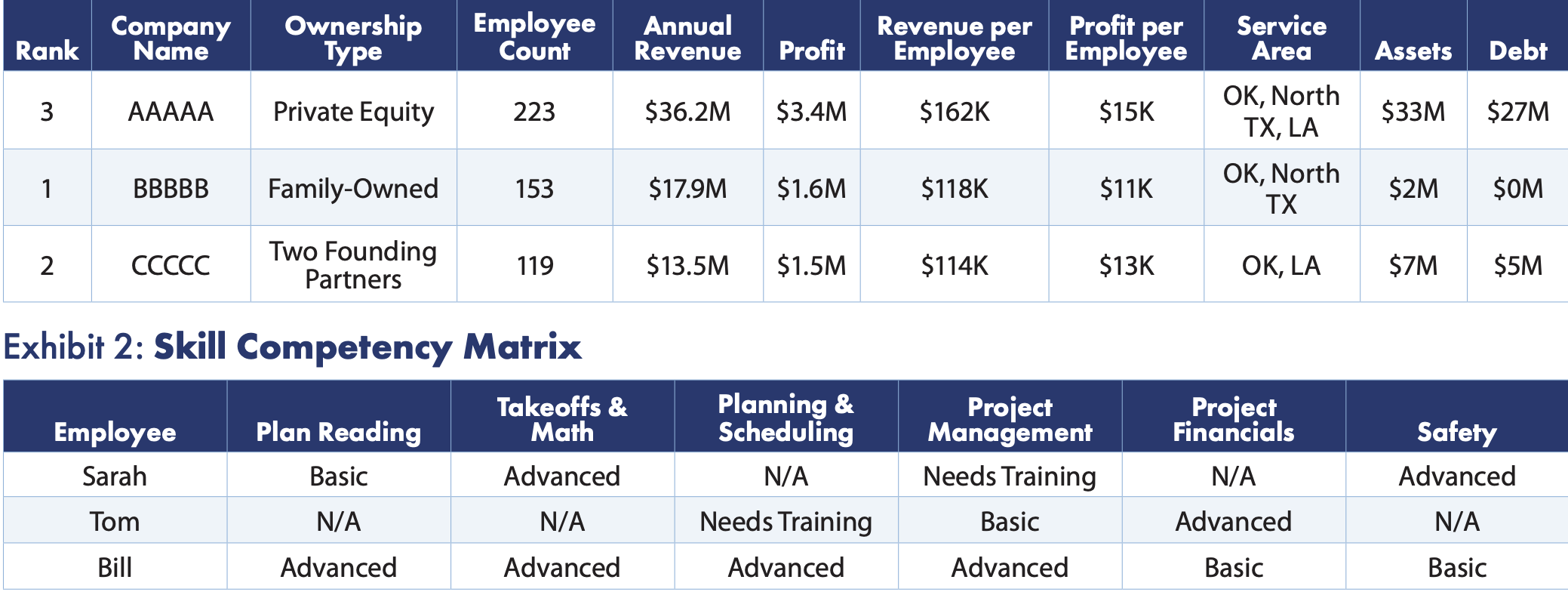
Exhibit 1 presents the target assessment and identification criteria typically included in an M&A acquisition. Remember to include accurate comparisons across target companies when designing selection criteria. Ensure that any differences are accounted for by “normalizing” any criteria to provide a like-for-like comparison. Private businesses are often unable to provide detailed information about their income, profitability, or client base because this information is not publicly available. To accommodate this lack of detail, the potential acquiring company may have to review client invoices, bills, job costs, and other physical documents to get the data required.
The prospects of completing a successful acquisition can often be heavily influenced even before the first target company is identified. A strong sense of strategic reasoning is necessary, which may be accomplished through multiple workstreams.
Many successful M&A companies leverage the diligence process to obtain essential knowledge of the target company, its management, key personnel, culture, and customer connections. They scrutinize the financial statements and the intangible assets that underpin a business’s success strategy. Most important, they have tools and processes to objectively
CFMA Building Profits September/October 2021
document the company’s value and assist them in creating pro forma forecasted financials for a future combined entity. They begin developing relationships with the potential target months before the transaction closes.
Successful acquirers have a methodical and systematic approach to M&As. They identify, narrow down, and pursue a perfect match, beginning with a thorough understanding of their present company’s portfolios. They do searches throughout whole industries, not just for specific businesses, and once the deal is signed, they take great care to handle each stage of post-merger integration.
In each scenario, the company assumes that the deal’s value will grow following the closing. However, at this point, many acquiring companies place a premium on financial performance only. They frequently assume that only profitable businesses make suitable acquisition candidates. Therefore, how does one accurately forecast future success? A best practice is to answer the following questions for each potential target acquisition:
1) Who are the company’s best clients? What percentage of the total revenue comes from those customers?
2) What is the percentage of total spending by the customers (for their business area), and what is the concentration among the customers? Does the entire business depend on a few customers? Is there room for expansion with each customer? If so, where?
3) How closely is the company linked with its consumers and, more precisely, with their needs and expectations?
4) What unsatisfied or underserved requirements do customers have, not only of the company but also of the industry? Where are the untapped opportunities?
5) How difficult would it be for the current management team and line-of-business employees to roll out and operationalize the strategic plan, including the transformation and integration stage?
Cultural Impact
While taking cultural best practices from each entity when two companies join is a common approach, individual corporate strengths are often incompatible.
When established contractors often purchase smaller companies to expand their service offerings, they quickly discover that their well-defined internal processes and financial management controls may be hard to integrate with smaller companies. When evaluating the impact of acquisition integration, culture must be considered since it can be directly connected to performance. Therefore, the actual financial performance KPIs of the group with the newly implemented cultural practices should be expected to improve.
CFMA Building Profits September/October 2021
Document the Integration Complexity
Documenting the integration complexity is a crucial component when identifying potential target acquisitions. Management teams may likely devote most of their resources to the area of integration after the purchase.
When evaluating the integration complexity, a matrix of skill categories by column and rows of competency with ratings from lowest to highest is typically recommended. These factors are considerably more challenging for some companies. Place names (or employee counts) in each of the categories of skill and skill level competency to evaluate the capabilities of the potential acquisitions (Exhibit 2). Generally, these integration issues fall into the following areas:
Employees With Supplementary Skills
These skills primarily reflect a strategy of additional services that add to the current company product offerings. As a result, they place a premium on a company’s capacity to transfer and efficiently utilize the talents and resources of one partner to the benefit of the other’s competitive advantage.
In general, the benefits of this sort of merger rise when shared talents and resources become a more significant portion of the cost of doing business. These criteria primarily reflect a strategy of related supplementary diversification. As a result, they place a premium on a target acquisition company’s capacity to transfer and efficiently utilize the talents and resources to the parent company for competitive advantage.
Employees With Complementary Skills
These skills and resources complement one another or fill gaps in the current company. For example: • A contractor is currently outsourcing most of its design work to a third party and can obtain an entire design group through an acquisition. • An acquiring company with only a junior and senior safety manager, but its acquisition targets have all jobsites walked twice weekly. Adding two new junior safety team members from an acquisition could allow an acquirer to achieve this goal immediately.
• A contractor with an understaffed HR department could acquire a target company with a fully developed, experienced HR team with recruiters.
Each of these examples indicate a related but complementary business acquisition strategy. They are concerned with
MERGERS & ACQUISITIONS
Identifying Strategic Acquisition Targets
enhancing the business’s competitive position by adding skill sets and resources to its existing talent pool.
Shared Services & Opportunities for Economies of Scale
These savings opportunities are achieved through integration and scaling back redundant functions across acquisitions. These gains may result from improved financial leverage, cash management, the ability to subsidize across company holdings, and enhanced employee resource allocation and training for both management and line-of-business workers.
Next Steps
Once the target businesses have been identified, rank them based on each assessment factor’s importance to the acquisition goals. For example, a Georgia-based company that focused on geographical expansion would emphasize the target business’s geographic footprint and rank it higher than a more profitable company with less geographic coverage.
Then, compile the information gathered for each potential target into detailed summary sheets, including overviews on why each target should be pursued for M&A action and the potential risks involved. Finally, summarize the scored metrics with an individual total for each potential acquisition.
Conclusion
While it is difficult to find an ideal acquisition opportunity in a fundamentally unpredictable and intense economic climate, there are no “perfect” deals. If a company waits for a once-in-a-lifetime chance to come along, it may miss smaller,
less obvious, but still viable M&A possibilities. By utilizing these processes and criteria to identify potential targets, companies will be able to create better-defined and highly actionable acquisition opportunities.
The final installment of this series will appear in the November/ December 2021 issue and address methodologies to minimize the challenges of integrating acquisitions to accelerate profit.
Endnote
1. www.cfmabponline.net/cfmabp/07082021/MobilePagedArticle. action?articleId=1708728.
DAN DOYON is Director at Maxim Consulting Group (www.maximconsulting.com) in Englewood, CO. Dan is responsible for assessing, evaluating, and implementing client processes. With more than 30 years of experience, he works with construction-related firms to solve complex business challenges to increase revenue and profitability. He is a published author and has been involved in many industry speaking engagements. Dan received his MBA from Georgetown University. He can be reached at 303- 688-0503 and dan.doyon@maximconsulting.com.
MICHAEL McLIN is Managing Director at Maxim Consulting Group (www.maximconsulting.com) in Englewood, CO. Michael is responsible for leading the business and guiding the strategic direction. He works with construction-related firms of all sizes to evaluate business practices and assist with management challenges. Michael is a nationally recognized dynamic public speaker and published author. He can be reached at 303-898- 8440 and michael.mclin@maximconsulting.com.
Exhibit 1: Target Assessment & Identification Criteria
CFMA Building Profits September/October 2021
© 2026 Maxim Consulting Group. All Rights Reserved.
