BY MICHAEL McLIN
BY MICHAEL McLIN
Companies across the U.S. have felt the immediate impact of the COVID-19 pandemic in devastating ways. Many companies in some industries have come to a complete and total shutdown, displacing more than 40 million Americans from their jobs since March 2020.1 One in four Americans have filed for unemployment since mid-March.2
Other industries such as the health care and medical research fields have seen excessive stress placed on resources and equipment, as well as a significant impact on the personal lives of the professionals who administer these services. These are truly unprecedented times that were unforeseen just six months ago.
The government has tried to do its part to care for the unemployed, the small businesses, and even some large industries that have been most noticeably impacted by the government directed shutdowns and forced isolation. The Coronavirus Aid, Relief, and Economic Security Act (CARES Act) has gone a long way to help move toward recovery, but it is not enough and cannot be the end of the support to corporations across this country.
Essential Services
Caught in the middle ground and omitted from these oftendiscussed areas of our society are the essential operations that have been asked to remain working during this pandemic. These industries traditionally provide food, basic human necessities, or some service that our government has deemed critical to the well-being of our citizens or to contribute to the economy in some way that prevents a total collapse of our infrastructure.
Many construction industry sectors are essential in many states across the country and have continued to provide services to both private owners and government agencies alike. They have done so while adapting and adhering to a continuously updated and changing set of recommendations from health, state, and federal government officials.
During this time of essential operation, much of the construction workforce continues to receive their paychecks and contribute to their pensions and health funds (rather than drawing from them), and projects are being completed per the schedule. These are all positives for the economy; however, the unintended consequence of being deemed essential and working under these new mandates has fallen directly at the feet of the corporations that employ this workforce.
Most of these construction companies work on fixed price contracts and have limited (if any) financial relief per the terms of their owner agreements. So, the added costs and inefficiencies of being an essential business are directly taken from the corporate profits. Without financial aid from the government, this industry will also suffer from the impact of this pandemic, but it will look different than the earlier impact that the legislative branch has tried to mitigate.
It could be months or, in some cases, a few years from the start of this pandemic until construction companies experience failure because they have no clear channel for equitable adjustment and have been contractually mandated to continue operations. The new normal resulting from the health and social modifications during this pandemic is being shown early in the construction industry, and Congress should take note as to what the potential financial or profitability ripple looks like as we start to reopen America.
Construction sites are usually vibrant micro-communities that thrive on fast-paced teamwork and require the precision of teams of people working together in tight spaces to erect massive buildings. Since nearly every activity on a jobsite takes more than one person to complete, social distancing creates a nearly impossible challenge.
Hundreds of people line up daily to have their temperatures scanned prior to beginning work. To create the needed space, they ride in elevators to and from their work areas at one-third the original capacity. Time spent simply getting to the work area takes up hours that were previously spent productively installing construction materials. Safety toolbox talks, stretch
July/August 2020 CFMA Building Profits
and flex programs, and daily meetings are all impacted as communication and coordination of activities has diminished at jobsites. While every activity is spaced at six-foot distances, each site has created their own version of shelter-in-place habits to reduce the potential spread of this virus while continuing to work. The construction industry thrives on challenge and innovation and will continually improve in order to safely deliver products to owners. In time, contractors will adjust and price the work of contracts appropriately. However, the current financial burden of the social restrictions on this industry may be so great that many companies will not survive.
Immediate Actions to Mitigate Risk
In order to mitigate some of the risks associated with the pandemic, contractors should take several of the following immediate actions:
1) Reserve your rights and put all projects on notice for cost and schedule impacts. Review your proposed letter with your counsel to ensure all aspects of your work are covered.
2) Clearly document the status of all projects using written narratives, videos, and photos. Loss and damage frequently occur to projects with work slowdowns, shutdowns, weather damage, etc. Insurance companies are strongly recommending that contractors take this action on all projects impacted by COVID-19. Contact your insurer to check if there is a specific format in which they require information, as the evidence is invaluable in the event of a claim. Share the information with owners, GCs, and subcontractors so everyone is made aware of the “as-was” condition before shutting down a site. If the site is already closed, then the recommendation is to request permission to gain jobsite access to document the project status.
3) Update your contract language to include pandemics, epidemics, quarantine, restricted access, and travel restrictions beyond force majeure.
4) Families First Coronavirus Response Act (FFCRA) and CARES Act – Get your paperwork in order and file as soon as possible for the FFCRA paid sick leave. If your company qualifies for and was funded under the Payroll Protection Program (PPP), understand that any forgiven portion of the loan is taxable to the flow-through entities. Complete your impact statement and associated analysis as soon as possible. Place the funds in a separate bank account to make an audit crystal clear.
July/August 2020 CFMA Building Profits
5) Establish a means to tracking costs associated with COVID-19. Add new cost codes to your enterprise resource planning (ERP) system, and instruct employees on how to use the codes. Isolate individual activities at the task level, and establish and document rules as to what situation will trigger the use of the new codes.
6) Evaluate business interruption insurance coverage. Most general liability policies do not allow claims under the current circumstances, but not all policies do. Determine if you may have coverage and inquire about adding future coverage. Additionally, inquire with your insurer and attorney about what exposure your company may have if one of your employees falls ill and spreads the virus on a jobsite, as this could cause impacts and/or closures.
7) Companies must be explicit in directing project and team leaders to immediately send workers home to quarantine for at least 14 days if they demonstrate symptoms of infection. In addition, anyone who has been in contact with the person demonstrating symptoms needs to be identified and sent home to quarantine for 14 days as well.
Cash Flow Considerations
It is imperative that contracts heed the lesson that more companies go bankrupt due to cash flow than profitability. In good times, growth in accounts receivable (A/R) consumes cash.
In down times, the most common mistake is not aligning overhead to volume quickly enough. In fact, 73% of businesses won’t survive past six months based on cash flow essentially stopping.
Contractors must address some specific cash flow issues to ensure their fate does not mimic the restaurant industry, which experienced a 100% drop in bookings beginning in mid-March due to COVID-19. Contractors have several strategies to consider when addressing some specific cash flow issues.
Do the Basic Blocking & Tackling
1) Conduct a forward-looking 12-week cash flow projection
2) Accelerate your A/R to less than 30 days for GCs and less than 45 days for specialty contractors
3) Decelerate your accounts payable (A/P) – Best in Class contractors are getting 2% discounts on 60-day terms
4) Expand your line of credit to 5% of annualized sales for GCs and 10% of sales for subcontractors
5) Reduce expenses to align the overhead to the volume
Conduct Lender Negotiations
1) Expand your line of credit – perhaps approach as temporary and convert to permanent
2) Explore payment deferral options
3) Explore interest-only payment options
4) Explore fee suspension programs
Evaluation Options with Capitalized Assets
1) Options to sell or lease back a building
2) Options to sell or lease back equipment
3) Evaluate micro-captives such as an 831(b) captive
4) Establish clear criteria for rent vs. lease vs. buy decisions
Other Options
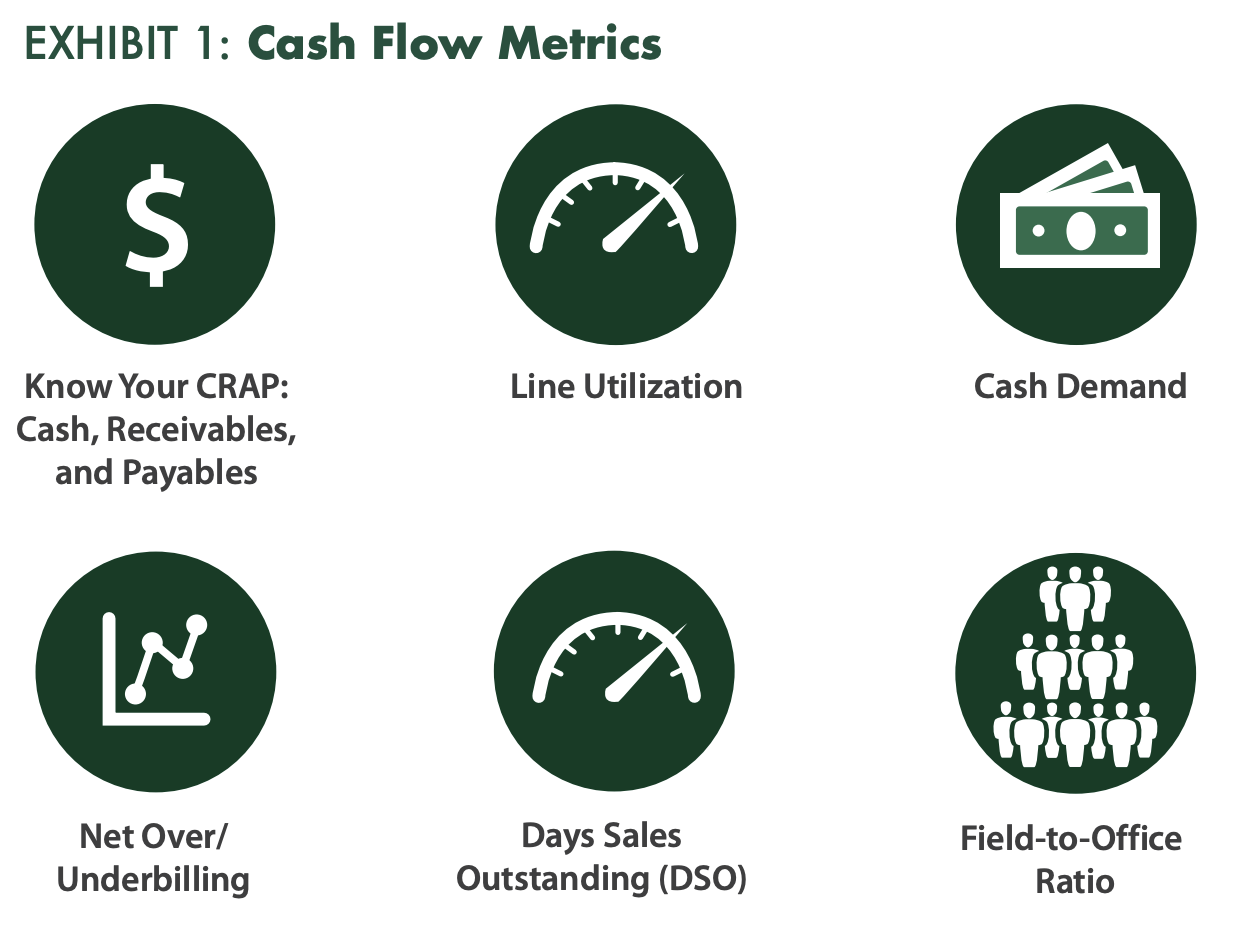
Contractors should also establish key metrics (Exhibit 1) that help monitor the overall health of their cash flow:
• Know your cash, receivables, and payables (CRAP)
• Line utilization
• Cash demand
• Net over/underbilling
• Days sales outstanding (DSO)
• Field-to-office ratio
Monitoring these metrics and establishing reasonable thresholds on the high and low side will help contractors quickly identify impending issues.
Using the Information: Projections, Proposals & Change Orders
Contractors should use the information previously provided for projections, bid proposals, and change orders (COs) by:
1) Immediately running projections on existing projects. Contractors should include the loss in productivity factors in their projections and adjust the company cash flow projections accordingly
2) Beginning the CO process on existing projects impacted by the pandemic and resulting guidelines. Contractors should gather documentation and examine contract language for CO administration requirements, examine contract language for force majeure clauses and/or language specific to “pandemics, quarantine, acts of God, etc.,” prepare to demonstrate out-of-scope work, and consult legal counsel as required.
3) Examining work under contract but not yet started and applying the percent modifiers previously mentioned. Contractors should begin change negotiation as described, reach out to equipment and material suppliers to determine if lead times are impacted from the original bid, and make sure to consider any additional shipping costs since time of bid.
4) Estimating bid rates as you normally would and applying a percent multiplier to cover costs for managing mitigation requirements for bid proposals. Contractors should assess each project for degree of impact as previously described, make sure to consider additional equipment requirements due to social distancing, etc., and reach out to suppliers on critical equipment and materials to assess impacts on lead times.
Conclusion
Uncertain times are certainly not a hall pass to stop planning; it’s more important now than ever. (See “Strategy Is
July/August 2020 CFMA Building Profits
Changing, Again: Why COVID-19 Supports More Strategic Thinking” by Tom Emison & Wayne Gray in the May/June 2020 issue for more on strategic planning.3 ) In the coming months, the overall impact will become clearer. At the time of this authorship, Maxim Consulting Group has been completing a comprehensive study on COVID-19’s impact on productivity. Preliminary findings are showing a 20% drop in productivity in the mechanical, electrical, and plumbing (MEP) trades.4 A rule of thumb for self-performing contractors is that a 10% drop in productivity is generally a 100% reduction in profit.5 The implications of this are far-reaching in terms of contractors seeking equitable adjustments, pricing on future contracts, and owners potentially shelving projects until there is more certainty.
As with most topics related to COVID-19, changes are occurring rapidly. Please note that this information is current as of the date of publication.
July/August 2020 CFMA Building Profits
Endnotes
1. Tappe, Anneken. “1 in 4 American workers have filed for unemployment benefits during the pandemic.” CNN. May 28, 2020. www.cnn.com/ 2020/05/28/economy/unemployment-benefits-coronavirus/index.html.
2. Ibid.
3. www.cfmabponline.net/cfmabp/20200506?pg=24#pg24.
4. “Pandemics and Construction Productivity: Quantifying the Impact.” ELECTRI International and Maxim Consulting Group. May 4, 2020. 5. Ibid.
MICHAEL McLIN is Managing Director at Maxim Consulting Group located in Englewood, CO. Michael is responsible for leading the business and guiding the strategic direction, and he works with construction-related firms of all sizes to evaluate business practices and assist with management challenges. Michael has developed a practical and objective perspective to solving business challenges. His areas of specialization include organizational assessments, strategic planning, project execution, productivity improvement, prefabrication, peer groups, and training programs. He is also a nationally recognized public speaker and published author.
Phone: 303-898-8440
E-Mail: michael.mclin@maximconsulting.com
Website: www.maximconsulting.com
© 2026 Maxim Consulting Group. All Rights Reserved.
