BY WALEAD ATIYEH
BY WALEAD ATIYEH
In a time of critical workforce shortages, developing the skills necessary to attract the best candidates is imperative. Once hired, however, the challenge then shifts to retaining your new hires. Embarking on a path to determine how to retain your new star employees through retirement is not only a plus, but a must.
Recruiting & Hiring
The goal of recruiting is to select and onboard talent to meet changing business needs. When aligning a recruit with those needs, the value to the organization is far greater than the individual cost of the employee.
To effectively hire an employee, it is critical to understand the skills and requirements necessary for each position. Those skills and requirements must be aligned with the company’s needs and organizational strategy. By focusing first on what role and necessary skills are required, recruits and employees can be evaluated against the position itself, helping to remove biases from the process.
When assessing a recruit, cognitive ability is the single most accurate predictor of job performance. Problem-solving, critical thinking, attention to detail, and the ability to digest or learn additional information are important qualifications for almost all mid- to high-level positions. There are four key questions to be explored when identifying each recruit for a specific position:
1) Is the candidate’s capability matched to the level of work in the position (i.e., does a plant manager candidate have the ability to plan and manage the work to deadlines that are 1-2 years away)?
2) Does the candidate have the technical knowledge, skill, and practice related to the position?
3) Does the candidate have the interest or passion for the work related to the position?
4) Does the candidate display reasonable behavior related to the open role?
An insufficiency in any of these key areas could be considered grounds to disqualify a candidate from an open position.
CFMA Building Profits May/June 2019
When interviewing candidates, behavioral-based interviews often avoid hypothetical situations and instead ask the candidates to discuss how they’ve acted in specific situations.
A common failure within many organizations is placing people in a position based on their technical abilities or skills even though they may not be able to operate effectively in the time span required for the position.
Managers should consider the following questions when determining if a candidate or employee is well-suited for a position:
• Decision-Making: What are the decisions that must be made to effectively complete the task prior to the deadline?
• Problem-Solving: What are the problems that must be solved to effectively complete the task prior to the deadline?
• Task Time Span: What is the appropriate length of time to complete the task?
The answers to these questions are not dependent on the candidate, but on the position and task itself, and can be used to stratify positions within an organization. The position stratification is most commonly recognized in the form of a hierarchical organizational chart defining duties and responsibilities. Work that is more complex, has more uncertainty, and is less divisible tends to rise to the top of the organizational structure.
Work that is more repetitive in nature – and where predictable results can be obtained from following processes, standards, and procedures – tends to appear toward the lower level of the organizational structure.
Most employees decide within the first six months whether they will stay within a given position. Therefore, developing and integrating an employee or candidate into a new position with full productivity is paramount. This effort to onboard or train an employee is rewarded by their ability to fully contribute.
strategic
Onboarding
The goal of an effective onboarding process is to build a positive connection with a new hire from day one and set expectations for the employment experience. Employee retention is closely tied to onboarding by creating a relational hold on the employee from day one to secure long-term commitment.
The most successful companies place a premium on the onboarding process with extensive new employee training and mentoring during the first few months. This is especially true for companies with unique processes, systems, or technologies that a new hire would not be expected to know.
The phrase “You only have one chance to make a first impression” is just as important for the hiring company as it is for the new hire. Between the acceptance of a job offer and the start date of the position, the hiring manager or other designated employee should be reaching out to the employee in the form of an e-mail or phone call to make the candidate feel welcome.
An employee’s first day should be a structured period where the new hire’s time is relatively scripted and should include meetings with their manager and/or team, breakfast or lunch, an introduction or tour of the facilities, and a designated desk with a computer, phone, etc., already set up.
To gain additional feedback, ask current employees what was or was not enjoyable about their first day. Companies should have a task list or schedule so the new hire knows where they are supposed to be and what they should be doing.
Communicating the expectations from the start may help new hires understand what they need to be doing and can prepare them for what lies ahead. Managers, ambassadors, and the new hire should also have a defined check-in after a certain period (e.g., 30-60 days is common) for feedback in both directions on the onboarding process.
Training
Once a candidate has entered the organization, one of the most important questions is who owns the employee’s development: the company or the employee? This development can be in the form of coaching and mentoring or formal training programs.
There are three primary forms of training and knowledge transfer that occur: verbal, visual, and actionable. The best training programs combine all three, developed under management direction, and aligned with the strategic goals of the
organization. Having the right instructors involved from the beginning will be helpful; keep in mind that the person with the most technical knowledge or best skill set in a position may not be the best speaker or trainer.
Trainings should be conducted in small groups, interactive, and utilize workbooks. If an employee can see a task occurring on a screen and perform the same task themselves on a second screen, then they are more likely to retain the knowledge.
Here is a high-level framework that every training program development model should follow:
1) Training Needs: The company should identify gaps (through surveys or other methods) in its employee knowledge and skill base. These needs should be clearly tied to the company’s strategic goals or needs.
2) Training Objectives: Once identified, the company should prioritize the gaps and turn them into training goals. The objective here is to close the gap between the needs identified in step one and the requirements of the company to operate as it is intended.
3) Training Plan: Create a plan that takes the training objectives and turns them into actionable steps, such as designing courses, materials, and content. This would also include identifying the necessary resources (e.g., web-based, video, in-person, and third-party). At this stage, the degree of training complexity, participants’ knowledge base, and learning styles should all be considered.
4) Training Implementation: This includes scheduling the trainings, organizing any external and internal resources, launching the training program, and monitoring the program.
5) Training Feedback: The entire program should be continuously monitored and evaluated to determine if the delivery was successful and helped meet the needs identified in step one. Feedback from participants and instructors should be solicited and analyzed, and then used to revise the program if necessary.
Needs Assessment
When identifying the training needs, there are three levels of assessment: organizational needs, position needs, and employee needs. An organizational needs assessment considers the company’s stated strategic goals and aligns the needed skills and knowledge to meet those objectives. The
May/June 2019 CFMA Building Profits
position needs assessment looks at each position and identifies the skills required to perform that role within the company. The employee needs assessment looks at the performance of the individual and determines what training is needed.
Reviewing performance assessments for trends can help determine if there is a prior pattern of failing to meet expectations that proper training can rectify.
Employee Promotion & Retention
A key component of employee development and retention is providing constant feedback and performance appraisals, usually through a performance management system. The goal of any performance management system is to minimize rater bias (which occurs when one’s values or biases distort the rating resulting in leniency and severity variance) and ensure that scoring standards are applied evenly.
Performance appraisals look to improve employee performance by measuring and analyzing an employee’s job performance. This process should result in objective, reliable
feedback used to develop and motivate employees.
Having multiple layers of review, creating objective metrics where possible, and giving rater training on applying standards are all mechanisms to reduce rater bias.
Clearly defining an employee’s performance requires three key items:
1) Specific competencies by position
2) Individual performance objectives developed by both the manager and employee
3) Alignment with organizational strategy and culture
Promotions are often tied to an individual’s performance. Junior positions (e.g., project engineer and assistant project manager) can typically be promoted when an individual exceeds expectations at their current level, which can be automatic based on the rating. More senior positions require either a business case or a demonstrated need.
Exhibit 1: Types & Impacts of Incentive Compensation
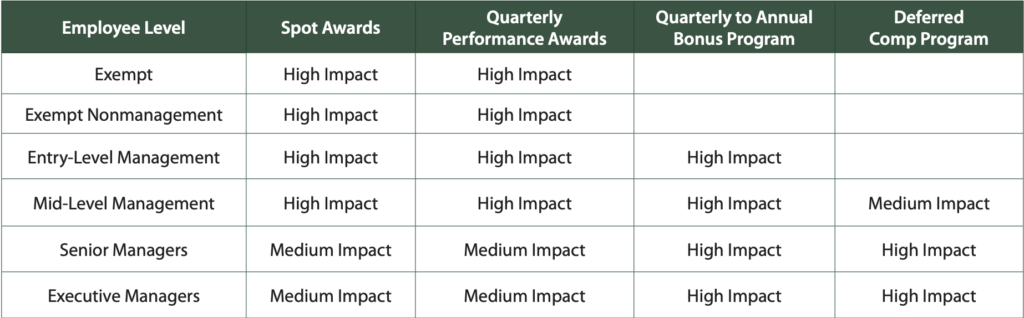
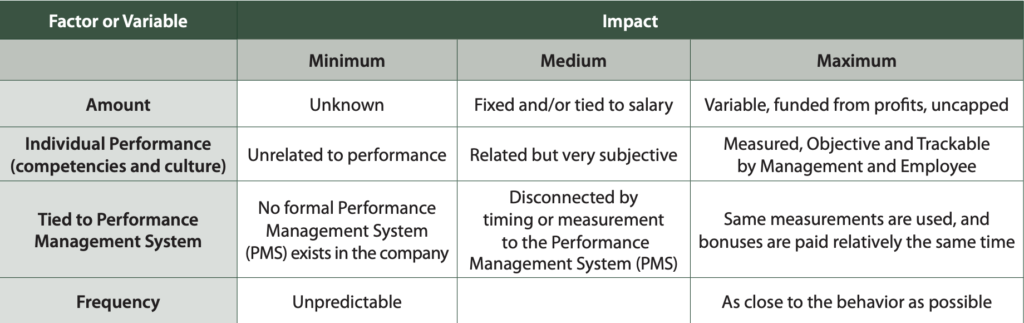
Exhibit 2: Factors Affecting Impact of Incentive Compensation Programs
CFMA Building Profits May/June 2019
strategic
Most employees get promoted because the organization requires them to fill the position whether the candidate is ready or not. The performance standards of each position identify when a candidate meets the standards of both the current position and the next position.
Employee retention is closely tied to the compensation systems in place, with key principles being:
• All compensation and bonus systems incentivize certain behaviors
• High-impact systems need to tie into performance management systems
• Some plans reward either individual or group performance (high-impact plans consider and measure both)
• Task performance and “firm behavior” are measured and rewards are weighted appropriately
• Still have flexibility for managerial discretion
All compensation programs should be connected to the strategic plan for the company. These include spot awards, performance awards, bonus programs, and longer-term deferred compensation. Further, the variability of these compensation programs increases with position complexity and responsibility.
Exhibit 1 on the previous page illustrates the level of impact that various incentive compensation programs can have on different positions. For exempt and nonexempt (nonmanagement) employees, the use of short-term performance awards and spot recognition techniques tend to have higher impact. For entry- to senior-level managers, it’s more impactful to tie incentive compensation to behavior as part of the performance management system. Executives are like managers but have additional deferred compensation such as stock and stock options. These are generally related to the attainment of longer-range goals with the focus on exceeding objectives.
The four key variables when creating an incentive compensation system is the amount, the individual performance, ties to a performance management system, and the frequency. Exhibit 2 on the previous page shows how to use those four variables to maximize the impact of incentive compensation regardless of the type of incentive.
Future Planning
Bench depth and succession planning is critical for all organizations, especially now when workforce shortages are of utmost concern. Contractors that develop and execute a plan to manage their bench depth are preparing their organization for future leadership transitions and creating
a competitive advantage in the marketplace. Unfortunately, this often takes a backseat to the urgency of managing daily operations, people, projects, business development, etc.
Organizations that place a premium on building their talent pipeline often face a challenge where people who grow quickly are consistently looking for new opportunities, whether that be an internal promotion or a larger role outside of the company. Organizations must prepare for these by not placing a reliance on any single employee.
Compounding the development of bench depth is an evolution in how careers are mapped and developed. In a 20th century mentality, bench depth and succession planning were characterized by a ladder advancement strategy, formal training, learning from mistakes, and long-term commitment. In recent years this mentality has been upended by different techniques for career mapping: lateral and ladder advancement choices, real-time feedback, teaching via mentoring, and always looking ahead.
Conclusion
Executives, managers, and other stakeholders must have a deep understanding of their company’s culture and align employee performance and development with their organizational strategy. This ensures that employee behaviors are consistent with the company’s overall mission. As such, the complexity and difficulty of defining positions and required competencies, evaluating candidates, and building leadership succession should continue to grow in difficulty at the upper levels of the hierarchy.
In addition, companies need to clearly identify and develop candidates internally in an effective way to attract, retain, and push employees into leadership roles and create a sustainable talent pipeline. Organizational strategy should be linked with personalized development plans and defining competencies and goals required by individuals assuming key positions. Then, identifying and putting in place the best talent into those key positions drives enduring organizations.
WALEAD ATIYEH, Associate Director at Maxim Consulting Group in Englewood, CO, is responsible for the evaluation and implementation processes with clients. He works with construction-related firms of all sizes to evaluate business practices and assist with management challenges. With extensive experience working in the industrial, telecom, and infrastructure construction markets, he is keenly aware of the business and, most specifically, operational challenges that firms face.
Phone: 303-688-0503
E-Mail: walead.atiyeh@maximconsulting.com
Website: www.maximconsulting.com
May/June 2019 CFMA Building Profits
© 2026 Maxim Consulting Group. All Rights Reserved.
