BY DAN DOYON
The past year has been a challenging one for the construction industry. Designated as an essential operation in most areas across the country, contractors have largely remained working throughout the pandemic. For these companies, the added costs and inefficiencies of being an essential operation cut into profits.
It could be months or years from the start of this pandemic until contractors experience failure and close or sell their companies because there is no clear channel for equitable adjustment, and they have been contractually mandated to continue operations.
We can see that the construction market will be increasingly competitive in 2021 given the negative infrastructure investment in the U.S. (Exhibit 1)
This new normal will require contractors to make investments that might ensure their relevance and survival in the long term but could reduce financial performance in the short term – an ongoing dilemma for contractors. How do you invest for long-term profitability while continuing to be profitable in the short run?
While challenging, it is not impossible to achieve with a structured and deliberate approach. We have found a strategy development process works best – define what you want to achieve in 36 months, and then work backward to create tactical strategies for today. This method flips the script on the standard approach of assessing your backlog and sales pipeline as a starting point to develop projections.
This approach will broaden the perspective of management, helping to confront the reality of potential challenges where a company could become marginalized from a profit perspective or in a case where the industry significantly consolidates.
Questions that contractors need to ask today to position themselves to maximize profits in 2021 include:
• Do we know how productive our teams are in the field and office?
• Are we investing enough in people to ensure we have the team in 12 months?
• Are we putting cost controls in place to mitigate project risk?
• Are we moving quickly enough in leveraging new data technologies to be more efficient and make better decisions?
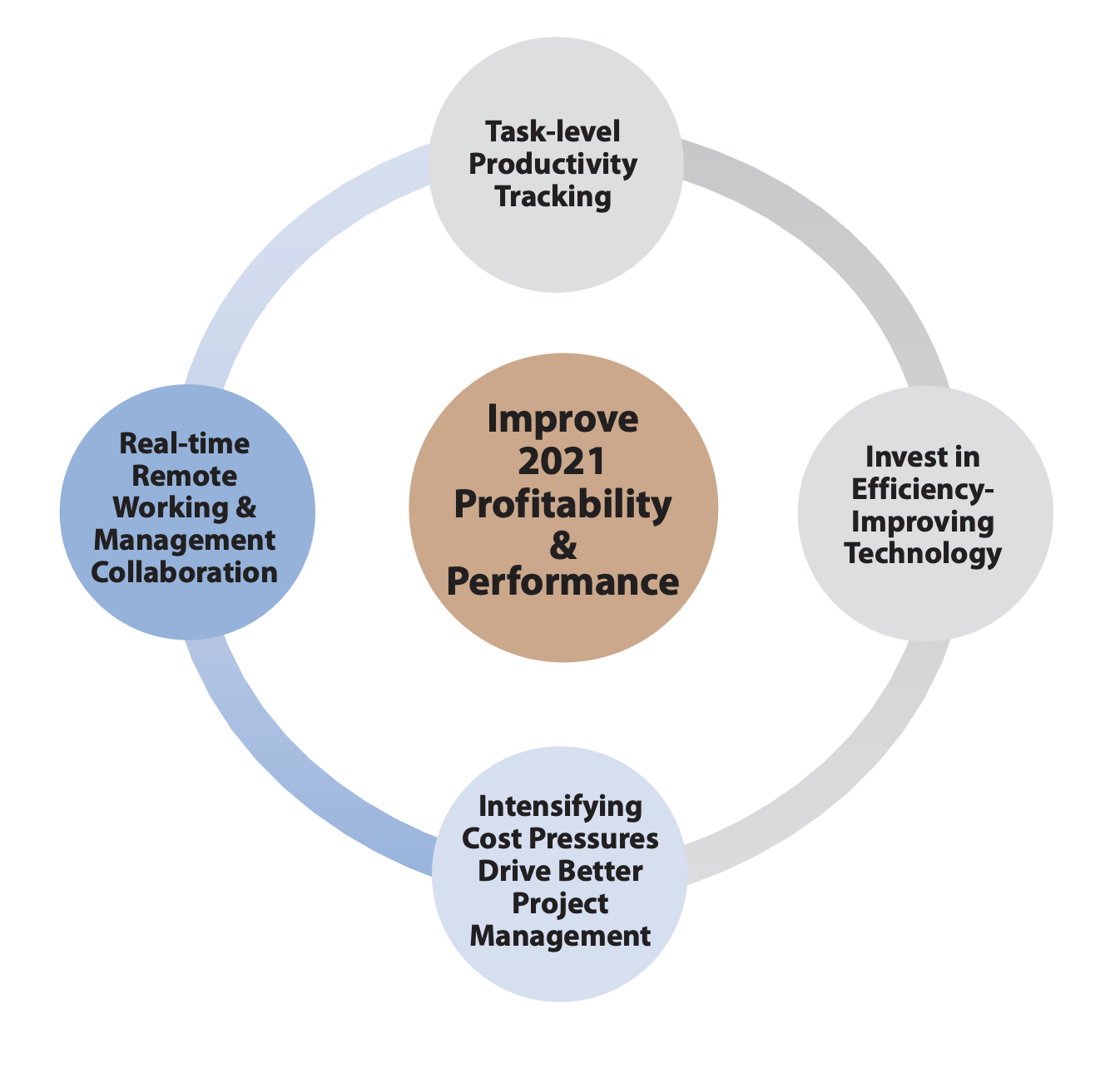
Let’s look at four key trends in 2021 that can help position contractors to maximize their profits.
#1: Task-Level Productivity Tracking to Support Change Orders & Contract Modifications
There are many terms used to describe productivity in construction including performance factors, production rates, unit person-hour rates, etc. The two most important measures of labor productivity are:
• The effectiveness with which labor is used in the construction process (e.g., to complete 1% of the work, it takes 300 man-hours)
• The relative efficiency of labor that is required to do a specific task at a time and place (e.g., to complete a specific task, it takes 120 man-hours)

These productivity rates are then measured over time to observe if they are improving or deteriorating. Productivity performance tracking is essential for long-term business success and insurance for profitability.
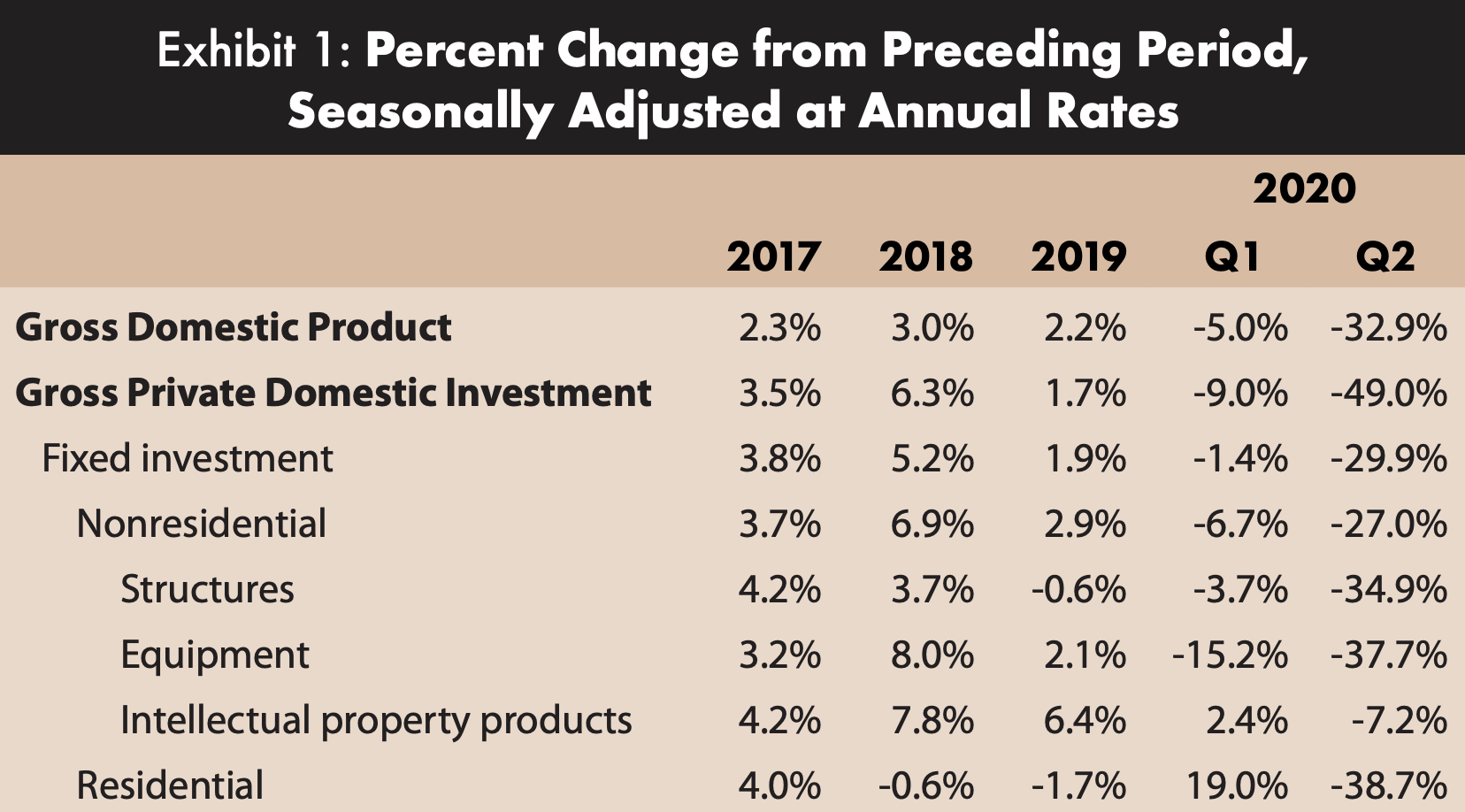
Source: “Gross Domestic Product, Second Quarter 2020 (Advance Estimate) and Annual Updated.” Bureau of Economic Analysis. U.S. Department of Commerce. www.bea.gov/sites/default/files/2020-07/gdp2q20_adv_0.pdf.
Exhibit 2: Improve 2021 Profitability & Performance
CFMA Building Profits November/December 2020
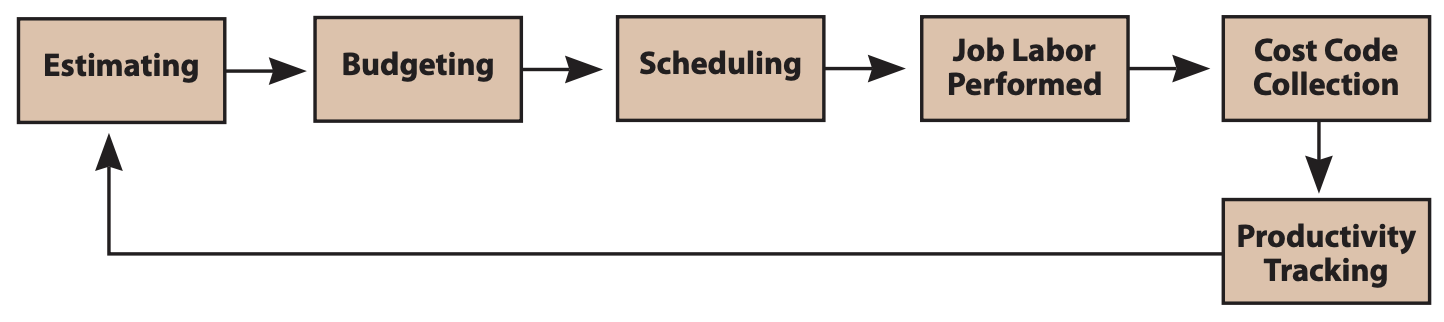
The data from tracking labor and expenses at the phase, area, and task level is crucial and creates a foundation for estimating, budgeting, scheduling, and performance-based bonus programs. Exhibit 3 shows how each step in the process relies on the prior one.
Here, estimating flows into budgeting, scheduling, and actual labor on the job; and, the cost code tracking is collected and productivity tracking is calculated. These calculated productivity rates are then used in future estimates and change orders (COs) to assist in creating a more accurate number.
Labor is the biggest cost for many contractors, and tracking time by cost code is the key to measuring labor productivity and protecting profits. Job costing helps provide visibility into how labor productivity is progressing against the estimated budget, and cost codes provide insight into the specific tasks that the project team is performing well on regarding labor efficiency or those that need to be examined for performance issues. The results collected from task-level reporting are valuable and can be used to generate estimates for future project work and to adjust the labor input numbers according to the team’s ability to perform tasks in the estimate.
For cost codes in which actual hours worked are more than the estimated hours, the estimator should increase the number of hours for that cost code for future projects to protect profits. On the other hand, for cost codes in which actual hours ended up lower than the estimated hours for that job, the estimator should decrease the number of hours, which would produce a more competitively priced bid. The actual results of task-level tracking have long-term benefits: tracking time by cost code toward job costing provides more accurate estimates to protect profits.
What can you do now? Make sure jobs in your accounting system are set up to accommodate costs and labor in categories by hierarchy in phase, area, and task.
Next, make sure your teams are reporting their time by cost code within each job. Once this data is being collected, it can be calculated over time to see performance of teams on tasks. This provides companies the ability to use this information for ongoing performance management and fine tune future project estimates down to the task level.
There is an additional profitability bonus for using productivity tracking. For external events such as COVID-19 that negatively affect the contractor’s productivity on a job, productivity data can be used as supporting information to bolster a case for a CO. In the New Horizons Foundation/ ELECTRI study, “Pandemics and Productivity: Quantifying the Impact,” the authors report an average of a 17.9% impact experienced by the combination of safety mitigation and work productivity.1
#2: Efficiency-Improving Technology to Differentiate Competitors & Drive Profitability
For many contractors, project governance and risk controls are manual, paper-based activities that do not provide analysis and reporting in real time. This is really the difference between viewing a project retrospectively (after-the-fact to review what happened) vs. prospectively (in real time so you can intervene and determine optimal profitability). An International Journal of Engineering Research & Technology study showed the repeating major causes of profitability found in almost every project are financial difficulties, insufficient labor productivity, and improper planning2 – all of which can be resolved when analytics technology is implemented.
The construction industry continues to face contracting margins lower than other industries, and management is very cautious about large capital expenditures related to technology.
The data from tracking labor and expenses at the phase, area, and task level is crucial and creates a foundation for estimating, budgeting, scheduling, and performance-based bonus programs. Exhibit 3 shows how each step in the process relies on the prior one.
Construction managers are sometimes hesitant to invest in technologies that require long-term investments when their companies’ revenue outlook has limited visibility beyond their current backlog. Lack of resources and remote construction sites make it even more challenging to implement additional technologies like modularization and automation.
However, new sources of project information can be combined to give management more insight into their operations than ever before to drive profitability. But with new technology evolving so quickly in an industry that historically has not been on the cutting edge of analytics, it can make the implementation and adoption of technology difficult.
Companies should look to find ways to create, store, and aggregate data, even if it is not clear that it might be useful in the future. This means companies can benefit from a data strategy that revolves around an information core to enable maximum analytical insight and operational efficiency. This might mean overhauling your IT capabilities or investing in external consulting expertise to consolidate and integrate real-time data flows to enable a full digital transformation. Integration of technologies should provide the company:
• Real-time updates from field workers • Tracked metrics and financials
• Automation of tasks and actions
Process automation technologies offer the ability to use unlimited amounts of the right data to make better decisions quickly. They also help boost scale and capabilities beyond human limits; and, over time, the technology learns to improve. The combination of learning technologies and process automation augments human reasoning and automates physical tasks. These systems can be trained to execute judgment-intensive tasks and will have an impact on your business now and in the future. The magnitude of disruption will be dramatic – it will be a profit-driven, generational shift. If planned and executed correctly, it can yield immediate financial benefits.
Exhibit 3: Productivity Data Collection Flow
November/December 2020 CFMA Building Profits
Exhibit 4: Benefits of Prefabrication & Modular Component Construction
What can you do now? First, optimize current systems and leverage data and analytics to create insightful, tactical reports and make better decisions to improve company performance. Next, develop a road map to identify those technologies and systems that have delivered a proven return on investment.
Construction is a complex process that requires access to large amounts of information, which then needs to be linked together in a way that makes sense for the right people at the right level. Doing this successfully means understanding how to collect, store, and analyze that data in an insightful and actionable way. This will provide immediate cost savings and timely information for management decision-making, as well as compliance and accuracy improvements.
#3: Cost Pressures Are Driving Companies to Plan, Manage & Execute Projects Better
By moving construction from the field to off-site manufacturing and field assembly sites, companies can become more effective and efficient in creating solutions that maximize material and labor resources, control initial costs, drive predictability and consistency, and introduce safety benefits as well.
As shown in Exhibit 4, all the benefits of the prefabrication and modular construction component have a financial impact and lead directly to profitability.
While prefabrication is not new, the industry has yet to broadly adopt this manufacturing technique. What can you do now? To be competitive in 2021 and drive costs lower, set up a dedicated shop area for creation of commonly used highimpact areas for prefabrication construction.
Given the significant commitment to overhead in a prefabrication shop, it must be adopted across the organization and integrated into the estimating process to achieve profitability.
CFMA Building Profits November/December 2020
The data from tracking labor and expenses at the phase, area, and task level is crucial and creates a foundation for estimating, budgeting, scheduling, and performance-based bonus programs. Exhibit 3 shows how each step in the process relies on the prior one.
Additionally, the repetitive nature of building common components leads to expertise within the prefabrication shop that should be retained and expanded into additional mediumand high-impact areas. The resulting quality and cost savings will lead directly to profitability.
Monitor and manage how best to retain key employees, suppliers, and contractors for your projects. This could mean having as many employees as possible continue working remotely, and, for those who are on the jobsite, ensuring there is proper handwashing, temperature checks, social distancing, and the availability and proper use of personal protective equipment (PPE) are all important. Promote the company PPE policies and adoption of daily jobsite temperature checks.
As newer and faster results from COVID-19 testing continue to become available and contact tracing methods expand, companies are challenged to keep processes and procedures current with state, federal, and OSHA regulations and recommendations. Leading companies are integrating these new methods and processes and communicating their proactive position to employees.
#4: Remote Working & Management with Real-Time Collaboration
As the use of mobile devices continues to advance in our daily lives, so does their application in construction. Thanks to the cloud and easy-to-use construction apps, workers in the field as well as those who are remote can access and collect data on their laptops, phones, tablets, or even wearable devices.
Insightful construction-specific apps also allow them to analyze data right from the jobsite, providing a real-time look at the true profitability and productivity of construction projects. By utilizing the cloud to collect and share data, mobile devices will continue to have a dramatic impact on construction collaboration and productivity in 2021.
What was a limited “work anywhere” option for some companies now must be considered permanent, even as companies begin to move some of their employees back into the office. This allows contractors to improve the employee experience and provides the opportunity to offer customers certain virtual interaction options.
Additionally, due to increased COVID-19 demand, most companies have invested in remote IT operations infrastructure, social distancing processes, and PPE, which has set the stage for the potential of lower costs, improved productivity,
reduced turnover, and broader access to diverse talent in the long term.
Given the following statistics, it may become the new normal of how we work:
• A 50% increase in remote work could lead to over $11,000 in savings annually per employee.3
• By 2022, 25-30% of the workforce will be working from home.4
• 79% of remote employees say remote work increases their productivity/focus.5
• 81% of onsite workers want to work remotely in the future at least some of the time.6 What can you do now? First, mobilize your workforce to apply the following framework:
•Work with human resources and management to adapt roles and responsibilities, performance metrics, and working methods to individuals and teams;
• Address the longer-term impact of increased demand for management and workforce flexibility on individuals and teams for remote work; and
• Define and execute the transition plan to a new normal state, where new processes have been integrated into the fabric of the organization.
Next, implement revised processes to incorporate new technology that provides real-time updates from field workers and remote workers to the office staff.
Conclusion
While there is plenty of promise in 2021, the economic, political, and health factors could lead companies to further focus on the bottom line and cutting costs. Investing in processes and technology now can help contractors be best positioned to meet the competitive new normal challenges in 2021 and might ensure their relevance and survival in the long term.
CFMA Building Profits November/December 2020
Endnotes
1. McLin, Michael; Doyon, Dan; & Lightner, Brian. “Pandemics and Productivity: Quantifying the Impact.” The New Horizons Foundation and ELECTRI International. 2020. www.newhorizonsfoundation.org/ project/pandemics-and-productivity-quantifying-the-impact-report.
2. V., Meena & Suresh Babu, K., “Study on Time Delay Analysis for Construction Project Delay Analysis.” International Journal of Engineering Research & Technology. March 2015. www.ijert.org/ research/study-on-time-delay-analysis-for-construction-project-delayanalysis-IJERTV4IS031166.pdf.
3. Lister, Kate. “Latest Work-at-Home/Telecommuting/Mobile Work/Remote Work Statistics.” Global Workplace Analytics. March 13, 2020. global workplaceanalytics.com/telecommuting-statistics.
4. Lister, Kate. “Work-At-Home After Covid-19–Our Forecast.” Global Workplace Analytics. globalworkplaceanalytics.com/work-at-home-aftercovid-19-our-forecast.
5. “Telework Savings Potential.” Global Workplace Analytics. globalwork placeanalytics.com/cut-oil.
6. “State of Remote Work Report 2019.” Owl Labs and Global Workplace Analytics. 2019. www.owllabs.com/state-of-remote-work/2019.
DAN DOYON is Director at Maxim Consulting Group located in Englewood, CO. Dan is responsible for the assessment, evaluation, and implementation of client processes. With more than 30 years of experience, he works with construction-related firms to solve complex business challenges to drive revenue and profitability. He has authored many studies, including the landmark reports on the productivity impact of COVID-19. Additionally, he has successfully led projects for design and transition to target staffing hierarchy model, IT infrastructure consolidation, business process redesign, financial and human resource system implementations, change management design, and contract and service level agreement negotiation.
Phone: 303-688-0503
E-Mail: dan.doyon@maximconsulting.com
Website: www.maximconsulting.com
November/December 2020 CFMA Building Profits
© 2026 Maxim Consulting Group. All Rights Reserved.
