


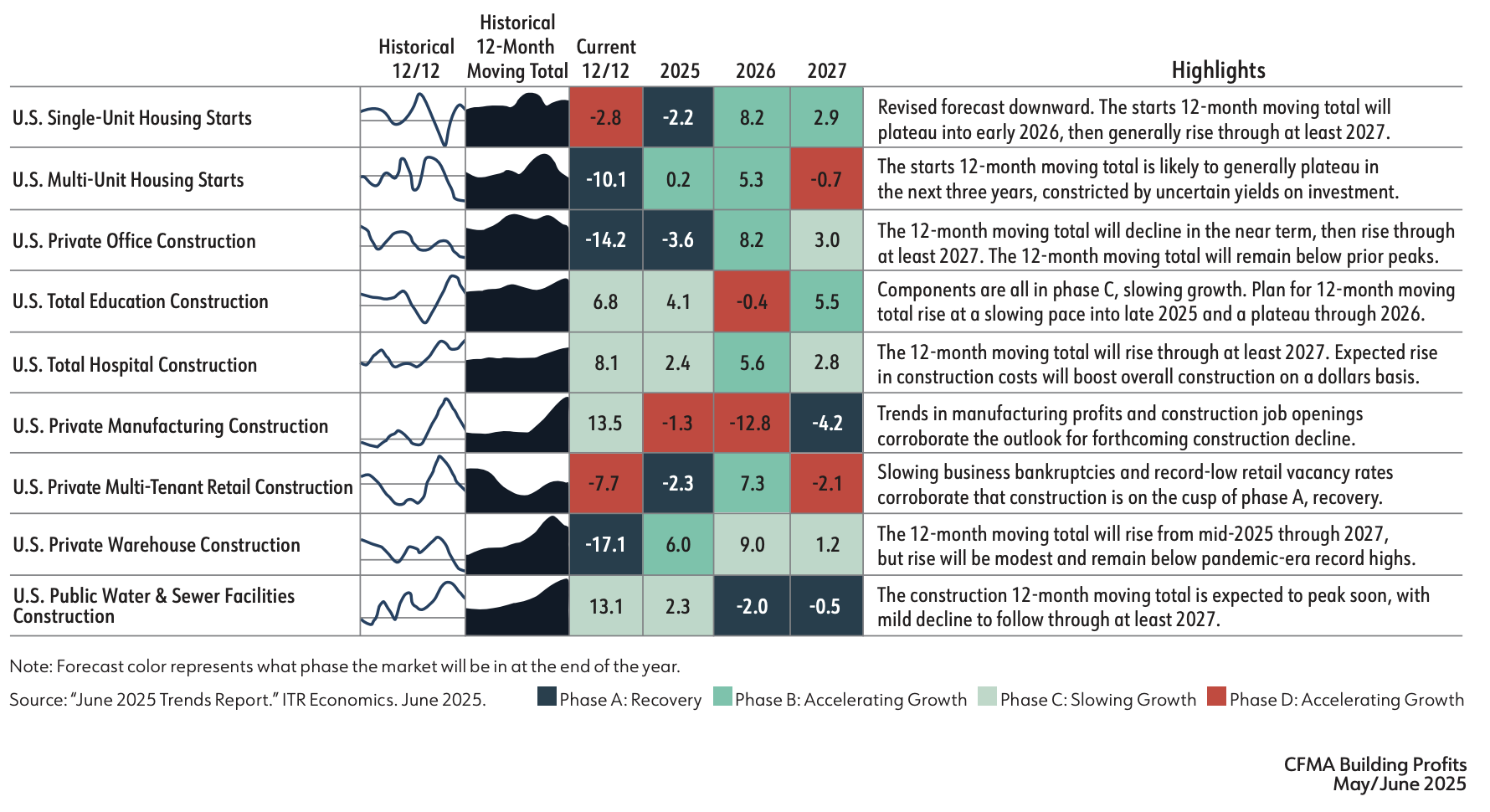
In 2025, housing starts are expected to modestly rise, kicking off a new phase in the construction cycle. While there will still be significant economic spend in the public works segment (largely due to the Infrastructure Investment and Jobs Act), housing is the key to a soft recovery. This market cycle is supported by the June 2025 forecast from ITR Economics (Exhibit 2).2 There are expectations of lower interest rates, with predictions of up to two rate cuts throughout 2025;3 however, significant economic headwinds remain. Inflation has been sticky due to key issues such as the national debt level, low unemployment, supply chain uncertainty, and worldwide geopolitical unrest. Through two quarters, the Federal Reserve has, so far, declined to implement rate cuts. Construction industry labor costs are expected to continue growth given the supply and demand constraints (not enough tradespeople, project managers, etc.). In addition, construction material costs are expected to rise 5-7%.4 Tariffs, or the expectation of tariffs, play a role in that. The combination of interest rates (and therefore, carrying costs), rising labor, and material costs will make it more difficult for project pro formas — a projected financial statement that estimates the costs, revenues, and profitability of the project based on assumptions and forecasts — to plan and gain construction loan approvals. It will also be more difficult to generate internal rates of return that make economic sense relative to other investment alternatives for privately financed projects.
TECHNOLOGICAL ADVANCEMENTS
AI & Automation Integration
Artificial intelligence (AI) and automation will continue to play a crucial role in transforming construction finance and accounting practices. The real challenge is identifying tools that can be easily integrated and provide a measurable impact by improving
With hundreds of AI tools, sorting them out can be difficult. Consider identifying tasks that have redundant data entry and start there. The automation that AI will enable is expected to streamline tasks such as data entry, reconciliation, and financial reporting. The finance department is typically the first to use AI tools to rename invoices to match the company naming convention, automate routing for approval, collate all the reports needed to complete a month-end cost projection, and establish target billing amounts to reduce revenue swings and missed expenses. Additional AI tools focused on preconstruction planning, procurement, project management, schedule optimization, and resequencing are already on the market. Add in drones and robotics, and the potential efficiency gains expand even further. These tools can help contractors complete more work with fewer resources, which is great news for an industry with so much scarcity. AI is expected to reduce construction costs by as much as 15% — a notable figure for a multitrillion-dollar industry.5 A whole new category of service offerings can be expected, with an emphasis on
innovation and industry collaboration driving new solutions into the marketplace. The scope of these solutions will likely focus on how payments are made from GCs to subcontractors and vendors. Another option is the deployment of contracts that have automatic payment upon completion of specific project milestones — think of what this would do for cash flow and revenue projections, with a goal of increased speed and transparency.
Cloud-Based Solutions
The adoption of cloud-based accounting software and software as a service (SaaS) platforms will continue to rise. The advantages include real-time financial reporting, access to data, and collaboration opportunities through dashboards and key performance indicators (KPIs). These tools are readily available and reasonably simple to deploy.
SaaS
The SaaS model allows contractors to focus on what they do well: building. The model affords greater data security and recovery options and capabilities, particularly with all the cyber threats that exist today. SaaS deployments are also making interconnectivity and integration among
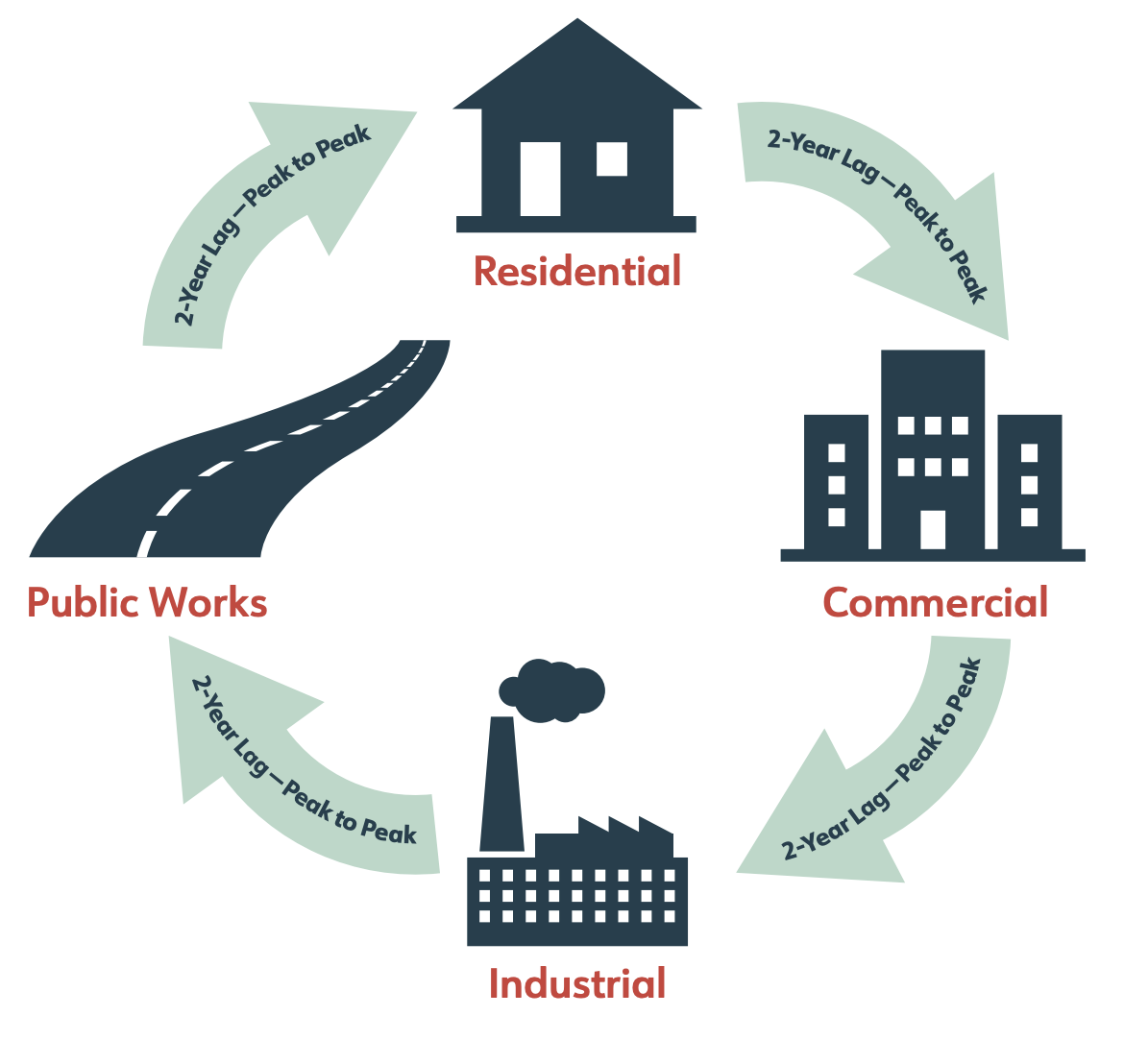
Exhibit 1: Typical Construction Economic Cycle
separate, disparate systems easier. The advent of sophisticated application programming interfaces, along with some platforms gaining significant market share, makes this more of a reality. While some software offerings still overpromise future functionality, vendors are increasingly delivering on meaningful integration capabilities.
Cloud-Based Systems
Cloud-based systems substantially open the door to the development and deployment of mobile apps. And because a SaaS license is assigned to an individual dedicated to a project, many times the licenses can be passed through as an expense rather than included as a part of the fee. This can present minor margin benefits when structured appropriately.
Data Analytics & Financial Insights
Accountants in the construction industry will increasingly focus on providing valuable insights through data analytics, removing subjectivity and improving decision-making. Data-driven decision-making and analytics should allow contractors to
improve profitability and productivity. Interpreting large volumes of data requires new tools and a better understanding of how to capture and model data. It is increasingly common to have a data analyst on staff that possesses skill sets never before considered a need in a contracting business. If you’re looking to hire a new data analyst, you can start them with basic, redundant tasks, such as a day in the life analysis of payroll personnel. This would allow them to understand what information is collected and how it is collected, stored, and used. A 2022 FMI study showed that about 96% of data collected in construction never gets used6 — it’s time to start using the information for predictive analytics. Assistance in job cost forecasts, cash flow needs, strategic market pursuits, and return on investment (ROI) information on key hires or new positions should be available to make intelligent, data-driven decisions. These capabilities will be foundational to modern construction financial management.
Improved Risk Control
The average business in the U.S. has about $830,000 in annual revenue.7 In many companies, numerous individuals are responsible for revenue far exceeding that threshold — yet often have little to no financial training. One of the key tenets of the most successful companies in construction is that their teams have a very strong financial aptitude. As credit markets have tightened up and bonding companies are scrutinizing contractor financials more than ever, effective financial controls are imperative. As 2025 continues, effective cost management will remain a top priority, with a focus on accurately documenting project costs and expenditures to maintain project profitability.8 For contractors, figuring out profit fade can be a problem. They need to know where the job is well before it is halfway done; at 50% complete is not acceptable. Contractors should identify problem jobs earlier in the life cycle — ideally by 25% completion — and implement proactive corrective actions. There are
Exhibit 2: ITR Economics Construction Market Outlook
many approaches contractors can take to accomplish this, but they need to be embedded into standard operating procedures. Even more importantly, more contractors often go bankrupt due to cash flow than profitability. Solid cash flow and a stable balance sheet are essential for financial stability. A strong emphasis should be placed on developing schedules of values with maximum front-loading, specific billing targets, and shortened collection cycles. These should be basic foundations embedded into everyday practices. Companies need to effectively manage cash flow; while it is basic blocking and tackling, it is being automated with AI tools, which can ultimately do a better job at managing the basics
EVOLVING BUSINESS PRACTICES
Prefabrication & Modularization
The continued rise of prefabrication and modular construction will also necessitate new financial approaches. As the means and methods of projects change, moving significant portions of the process offsite with prefabrication and modularization must also result in an evolution of cost-accounting methods. Most contractors can indicate that they made money on jobs, but they cannot attribute how much was made in prefabrication and modularization vs. onsite installation. Typically, all that is known is the total installed cost. Contractors will likely need to familiarize themselves with material requirement planning programs. Most mainstream enterprise resource planning (ERP) systems — or what many call their accounting system — do not have material requirement planning modules. Material requirement planning programs work using a combination of SKU optimization, material lead time, and building work orders for each assembly so that time and materials can accurately be costed. While Excel remains
common, more advanced systems will be necessary as prefabrication grows in both financial significance and operational complexity. Contractors will also need to consider the cash flow implications of prefabrication and modularization, as more upfront work means increased cash requirements. Banks, investors, owners, and GCs will all likely need some education to understand that the old-school s-curve of cash flow doesn’t accurately depict job progress — and contractors cannot afford to be the bank. New valuation methods for prefabricated components will need to be the norm for everything from preconstruction modeling and planning to procurement, from assembly to shipping. These values cannot be arrived upon accurately without proper systems that are beyond traditional spreadsheets. Ultimately, manufacturers don’t do it this way, so why would a contractor that happens to be manufacturing?
REGULATORY SHIFTS
Regulatory Compliance & Risk Management
With a new U.S. presidential administration, it is common to see evolving regulations. As we get later into 2025, construction financial professionals will need to focus on regulatory changes. Labor law changes and compliance requirements will likely continue to evolve at both federal and state levels. Compliance remains a cost center that finance teams must proactively manage.9 While some regulatory shifts may reduce costs, others may introduce new reporting obligations. Accounting systems must be kept current to have a clear audit trail that can prove the regulatory requirements were properly adhered to. In many organizations, the IT team is also assigned to the CFO. CFOs must work with their IT teams to protect
financial and other data from constantly emerging cybersecurity risks. As sustainability becomes a priority in construction projects, accounting practices are shifting to incorporate cost allocation methods that consider the life cycle benefits of sustainable materials and practices.10
MOVING FORWARD
These trends highlight the ongoing transformation within the construction finance and accounting sectors as the industry adapts to market dynamics, technological advancements, evolving business practices, and regulatory shifts. Embracing these changes can lead to significantly improved efficiency, profitability, and compliance. Staying smart on these trends — with help from your industry connections, a peer group, or talking with experts in this space — will enable you to keep pace with the only constant: change. BP

MICHAEL McLIN
is the Managing Director at Maxim Consulting Group (maxim consulting.com) in Englewood, CO. He is responsible for leading the business and guiding its strategic direction. Michael works with constructionrelated companies of all sizes to evaluate business practices and assist with management challenges. Having worked in the industry, Michael has developed a practical and objective perspective to solving business challenges. His areas of specialization include organizational assessments, strategic planning, project execution, productivity improvement, prefabrication, peer groups, and training programs. Michael can be reached at michael.mclin@ maximconsulting.com.
Endnotes
1. McGrath, Mary Kate. “Construction Industry Set for Growth in 2025.” Northspyre. January 3, 2025. north spyre.com/blog/construction-industrystarts-gain-momentum-for-anactive-2025.
2. “June 2025 Trends Report.” ITR Economics. June 2025.
3. Davidson, Paul. “Powell says Fed not ‘in a hurry’ to cut interest rates with ‘economy remaining strong.’” USA Today. February 11, 2025. usatoday.com/story/ money/2025/02/11/fed-powell-cutinterest-rates-senate/78394424007.
4. McGrath, Mary Kate. “Construction Industry Set for Growth in 2025.” Northspyre. January 3, 2025. north spyre.com/blog/construction-industrystarts-gain-momentum-for-anactive-2025. 5. Bunner, Grace. “Construction Trends to Look Out For in 2025.” Ganim Company. December 30, 2024. ganimcompany. com/blog/2025-construction-trends.
6. Biggs, John. “Not Capturing Data is a Missed Opportunity for Construction Firms.” Procore. January 20, 2022. procore.com/jobsite/not-capturingdata-is-a-missed-opportunity-forconstruction-firms.
7. “The Number of Businesses in the USA and Statistics for 2024.” Clearly Payments. May 24, 2024. clearlypayments.com/ blog/the-number-of-businesses-in-theusa-and-statistics-for-2024.
8. “BCG’s Guide to Cost and Growth: Strategic Insights for Navigating Economic Uncertainty.” Boston Consulting Group. January 2025. webassets.bcg.com/a7/8a/e7d5ec5f4f1d 849f4e5391d4711b/bcg-executiveperspectives-bcgs-guide-to-cost-andgrowth-2025-15jan2025.pdf.
9. Micheli, Chris. “How Many Total Regulations Are in California’s Code of Regulations?” California Globe. May 23, 2022. californiaglobe.com/fr/howmany-total-regulations-are-incalifornias-code-of-regulations.
10. Sadliwala, Mustafa & Gogate, Nivedita. “Life Cycle Costing Methodology for Sustainable Construction.” IOP Conference Series: Earth and Environmental Science. 2022. iopscience.iop.org/article/10.1088/ 1755-1315/1084/1/012023/pdf.
© 2026 Maxim Consulting Group. All Rights Reserved.
